
By all accounts, the Nigerian electorate did not need to be prompted by cartoons, mockery, or musical protest to overwhelmingly vote for opposition candidates in the 2023 elections. The disgust against the "political class", its patronage system, and neglect of public services such as health, education, and security had and has become widespread in the country, increasingly fuelling not only political protests, but also armed rebellion, ethnic tension, crime, and a desire to "japa", simply migrate away altogether. In 2023, the ruling elites only held on to power through massive, globally recognised fraud.
But satire, and the participation of famous satirists with large social media followings in protests, have helped to bring Nigerians to the point where the old feels tangibly under threat.
Performers speaking out
The dynamics between political and artistic engagement, aided by the internet, first came to the fore in a big way when, in October 2020, rap artist "Fresh Emir", together with other celebrities, participated in the #EndInsecurityNow protests in Kano. On the occasion, the performers spoke out against both police brutality and the state's singular incompetence in addressing widespread criminal gang activities such as kidnapping, abuse, and rape.
At the same time, cartoonist Mustapha Bulama was gaining tens of thousands of new followers after a drawing published in the north’s main newspaper, Daily Trust. The cartoon showed then First Lady Aisha Buhari standing on a podium, gloating about her daughter’s lavish wedding that year, while below the podium were ghost-like, poverty-stricken masses drowning in hunger and starvation.
“The First Lady was really angry”
Ironically, the cartoon had been prompted by the First Lady’s own photo of the wedding on her Instagram. "I didn’t know the impact of that cartoon until I began to receive calls," Bulama told ZAM in an interview. "And the First Lady was really angry."
In an almost textbook Streisand effect case, the First Lady made matters worse for herself when she drew more attention to the cartoon by directing her Special Adviser on Media, Aliyu Abdullahi, to respond to it, which he promptly did, saying the drawing was "very unfair", "not in any way insensitive", "only meant to thank well-wishers", and not to "rub it on Nigerian faces."
"Then, I received calls from the British Broadcasting Corporation (BBC) to speak about the cartoon," says Bulama. "Other journalists also called for my reaction. A local television station, Arise TV, invited me for an interview. Also, I received an invitation to speak on TEDx. It was quite massive."
Not learning many lessons, the First Lady committed another gaffe when, in 2022, she brandished photos on Instagram of her daughter-in-law Zahra Buhari graduating from a university in the United Kingdom. "The woman has this habit of celebrating at a time when Nigerians are angry," Bulama says, smiling.
Politicians are portrayed as vultures
At the time of Zahra’s graduation, Nigerian universities had been shut for about six months due to disputes between lecturers and the government over the underfunding of public universities and unpaid academic allowances. Bulama’s drawing combined references to students carrying placards screaming "Fix Our Universities" with the Buhari daughter-in-law’s graduation in the UK, a country where most Nigerians can never aspire to go for education. Bulama has also drawn Buhari himself, with one depiction of the now late president showing him as having eaten his fill and picking his teeth, unperturbed by hunger, inflation, and other social problems in the country. (The cartoon went viral, but Buhari never responded in the counterproductive way his wife did, even labelling the cartoonist as "his favourite.")
The cartoonist has since moved on to Buhari’s successors, gaining followers again at election time in 2023, with cartoons that focused heavily on political manipulation, the failures of the Independent National Electoral Commission, and the exploitation of the electorate. Throughout, his work is interspersed with his by-now trademark portrayals of politicians as vultures circling helpless, impoverished Nigerians, awaiting their "turn" to exploit the country's wealth.
Being a bridge
Bulama says he sees himself as part of the media in general, and that the media should always be a "bridge between the government and the people. The media tells the people what the government is doing. At the same time, the media tells the government what the people want." According to a scholar of Hausa art at the National Open University of Nigeria, Ebrahim Sheme, Bulama especially stands out because he addresses social and economic issues in both English and Hausa, a language spoken widely in the country’s comparatively poorer and violence-tormented North.
A similar Hausa-directed breakthrough has been achieved by the cartoonist’s musician colleague Fresh Emir (real name Adam Abdullahi), who also hails from the north and draws large audiences with socially aware lyrics in a region where music in the vernacular Hausa is still largely dominated by love songs and dance tracks. With his songs, Fresh Emir addresses social neglect and institutional injustice, advocates for peaceful protest instead of violence, and even confronts youth about drug use. His socially conscious music has seen him rise to prominence across digital platforms, earning him a massive following on YouTube, TikTok, Audiomack, and other streaming platforms.
“Proud of you. Forward ever, backward never.”
Like Bulama, but from a younger audience, he too gets calls and messages daily, ranging from Nigerian youth who want to follow in his footsteps and ask for tips, to those who simply send compliments. A recent bouquet reads: "Emir, you break my heart with your songs. May God elevate you more"; "Sir, proud of you, brother. Forward ever, backward never"; and "I dey with you, Aku Mai Bakin Magana."
Talking parrot
Aku Mai Bakin Magana, meaning "Talking Parrot", is Emir’s nickname, derived from his widely successful A Yau (Current Affairs) series. Conceived as a platform some seven years ago to address societal challenges, the series highlights corruption, lack of education, youth frustration, and violence, while calling on Northern Nigerians to unite and criticising leaders who enrich themselves while citizens suffer. The appeal of the A Yau series is enhanced by Emir’s blending of the region’s oral traditions, using metaphor and repetition, with satire and direct commentary. The resulting audio delivers parrot-like truth-telling, urgent calls to action, and poetic rhythm.
“His voice resonates even within conservative society”
Entertainment commentator Comrade Abba Ibraheem Samba says he is not surprised to see some of Emir’s work, like various episodes of the A Yau series, claiming close to a million views on YouTube. "It’s because he has a unique style, marked by distinctive verse arrangements. His baritone voice resonates even within conservative Hausa society. And fans see him as a hero, freedom fighter, and voice of the masses, one of the few artists consistently addressing government officials, politicians, as well as Islamic scholars."
Public discourse in the north, which is predominantly Islamic, is influenced by all these, and it is in this intersection that Emir plays his role: something, Samba stresses, that is not at all common in the music scene. "Many singers avoid social issues in Northern Nigeria, especially insecurity and government policies. Even when they do, they often act collectively. Fresh Emir was among the first solo artists to openly campaign against insecurity and challenge the government to fulfil its responsibilities."
“Nothing but the truth”
Speaking to ZAM, the young singer said he "wants to address the issue of Nigeria’s insecurity and unfulfilled presidential promises. I send a message to authorities on the socio-economic problems we face, especially in the northern part of the country." Describing himself as an awareness campaigner rather than an entertainer, he also said he "doesn’t fear" retaliation from the powers that be in Nigeria’s volatile north, where power often comes with violence, and politics rub shoulders with crime. "I have been asked where I got the guts to compose such (songs) and release the video without fear; if I wasn’t afraid of being arrested. I simply laughed and told them I haven’t done anything wrong by speaking for my community. I believe if someone has such fear, we would never make progress as a people. I am not afraid of being arrested because I haven’t done anything wrong. What I say is nothing but the truth."
Messages from the youth are the most inspiring
He is happy with the recognition he has earned, even from some institutions. "Hausa speakers identify with it. The National Drug Law Enforcement Agency once used my songs in its campaigns against drug abuse. I received an award from Bayero University, Kano, too." But the messages from youth who listen to his work are what inspire him most, he adds. Recent Audiomack data confirm a sustained and growing following, with episodes of the A Yau series amassing tens of thousands of plays and hundreds of playlist additions long after release.
Minimal encouragement
While, according to broadcaster and analyst Aminu Abba Umar, known as Nomiis Gee, Northern Nigeria’s entertainment industry offers minimal encouragement to artists despite abundant talent, Fresh Emir manages to make a living from his following, booking fees, and royalties. Cartoonist Bulama says he is not as lucky. "My following doesn’t translate to financial support, which sometimes discourages me." Apart from his cartoons that appear in Daily Trust, and on Facebook and X (formerly Twitter), Bulama therefore also illustrates children’s books and animated videos for a living. In 2014, he even adorned a biography of now former president Buhari, who was then not yet elected president. "But that did not stop me from criticising his presidency later," he says. "Additionally, some people ask me to paint their portraits or illustrate places or houses for them. They still want original work."
The public is unlikely to engage with a bot
Bulama has some concern about the inroads made by Artificial Intelligence tools in the cartoon sector. "Some see it as a rival. But AI cannot generate ideas on its own — the creativity comes from us." The public may also be unlikely to engage with a mere bot, while Bulama’s cartoons have close to half a million followers.
From under the veil
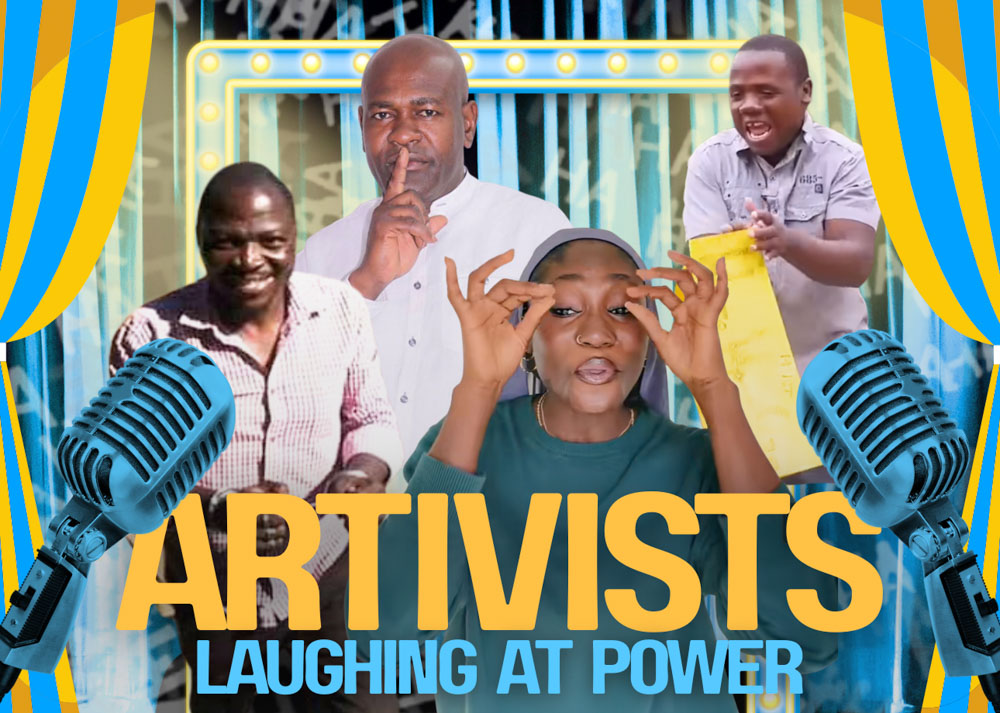
Known for her bitingly funny social commentary, TikTok star Hauwa Lawal has no qualms about having to promote deodorant or toothpaste to make a living, as long as her messages get across to her following of over 600K, mainly young women. Identifying as a Nigerian Muslim woman and acting out sketches with expressive gestures from under her signature large headscarf — struggling to cover her head, sometimes hiding under it, sometimes waving it around — "Hauwa" is a social media sensation in Nigeria.
Shrugs, eye rolling, and playful acrobatics add spice to her everyday commentary, often starting with everyday occurrences in women’s lives, like having to cook with no money, dealing with aunts who want you to get married already, or simply suffering under the government. The funny texts, in which lamentation is blended with satire, rhetorical questions, direct address, contrasts, and vivid imagery, result in video clips that are both testimonial and prophetic, echoing traditions of spoken word and political oratory, and seem designed to provoke moral outrage as well as collective responsibility.
“The ruling party makes me steal”
In a short video on Eid Mubarak, the Muslim festival during which rams are sacrificed, for example, Hauwa takes a swipe at the rising cost of living and the fact that government fails to even bring down the prices of goods in order to convince people to vote for it in the next election. "My daddy has been buying rams for 40 years without tears. Now it’s my turn to buy a ram, and I’m told to bring ₦700,000 (US$513). If you read the scripture about the sacrifice of the ram, you’ll see that Allah gave a ram to Abraham at the point of sacrifice — Abraham didn’t buy the ram. Okay, I’ll now start stealing rams for the sacrifice. I’m not going to spend a fortune to buy one. If you don’t want me to steal, then the seven million Nigerians who voted for APC (the ruling party) in the primary election should donate money for me to buy a ram for Eid. Eid Mubarak, catch you later…" Jumping out like an acrobat, she then disappears.
Fighting for Punch
Most of her work has a light-hearted touch to it, like when she pokes fun at young women who still call their exes even though they never pick up their calls, asking them why they care about guys who may be as "devious" as (President) Tinubu, or dangerous "like a lion in the zoo," or a "brutal criminal", and why they don’t move on with their lives. In a more edgy skit, she exhorts women in abusive relationships who think they can "change a man" to continue accepting abuse, while she stays with her "gentle nerds".
Nobody is safe
But there are even more dramatic and hard-hitting monologues too, like when Hauwa laments the recent kidnapping of about 40 schoolchildren from a primary and secondary school in South-West Nigeria. Titled "Nobody is Safe", it mocks the safety warnings routinely issued to women and girls in Nigeria. "We are warned: don’t go out at night — so we don’t go out at night. Don’t follow strangers — so we don’t follow strangers. Stay in the house. Yet people are being taken from their homes, and women are being raped and killed in their own homes. The people who are safe in this country are the wealthy — those who have foreign passports, not Nigerian green ones — who can escape from this country with ease. Those without foreign passports are stuck here."
Later on in the video, she urges her audience to "open its mouth": "There are women who are kidnapped. We know what happens to the women and girls there. If you don’t open your mouth to speak out against evil, you have failed them — children, women, girls whose hands have been tied behind their backs and who are being beaten." With over 100K views, this video is among her most-watched.
The right toothpaste is needed to get out of Nigeria
Hauwa also uses comedy when advertising products on her platform. In one toothpaste advertisement, a short clip shows two young men in Canada and Australia seeking young women in Nigeria for marriage. Is this a chance to get out of Nigeria? Hauwa listens attentively and hopes to be considered, but the narrator’s voice declares that she would not be recommended to anyone because her "mouth smells".
See all the instalments in this Transnational Investigation here
Africa | Artivists
Zimbabwe | The parody tsunami
Cameroon | Dents in the dictatorship
Malawi | Presidents of the poor
Call to Action
ZAM works towards a new equal relationship between Africa and Europe. Contribute to our mission by donating.