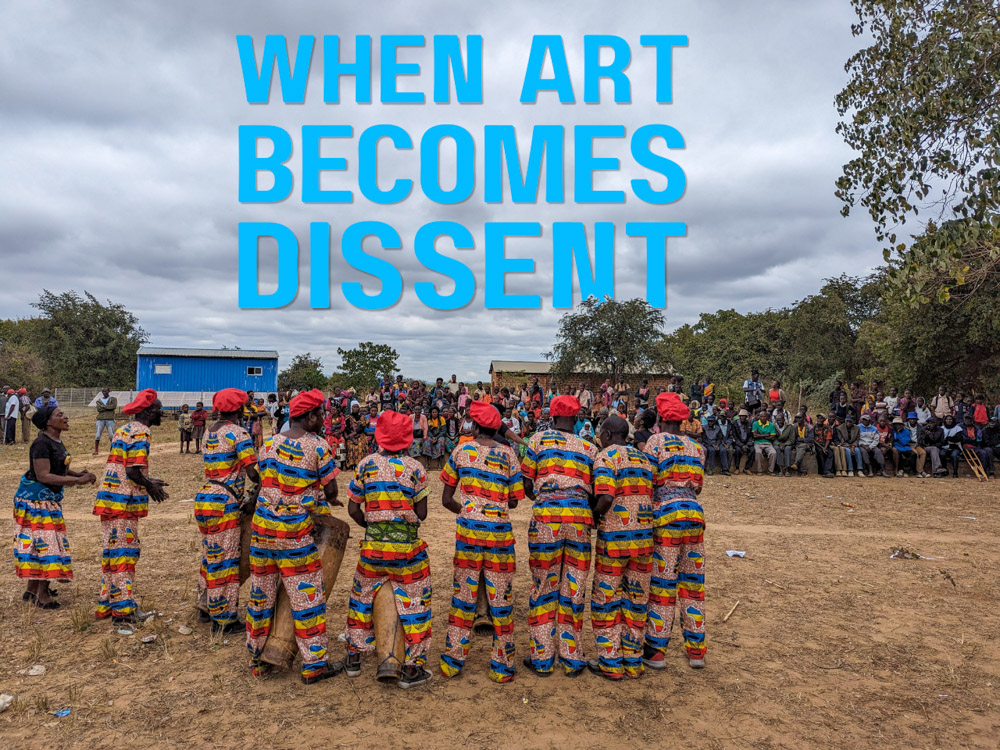
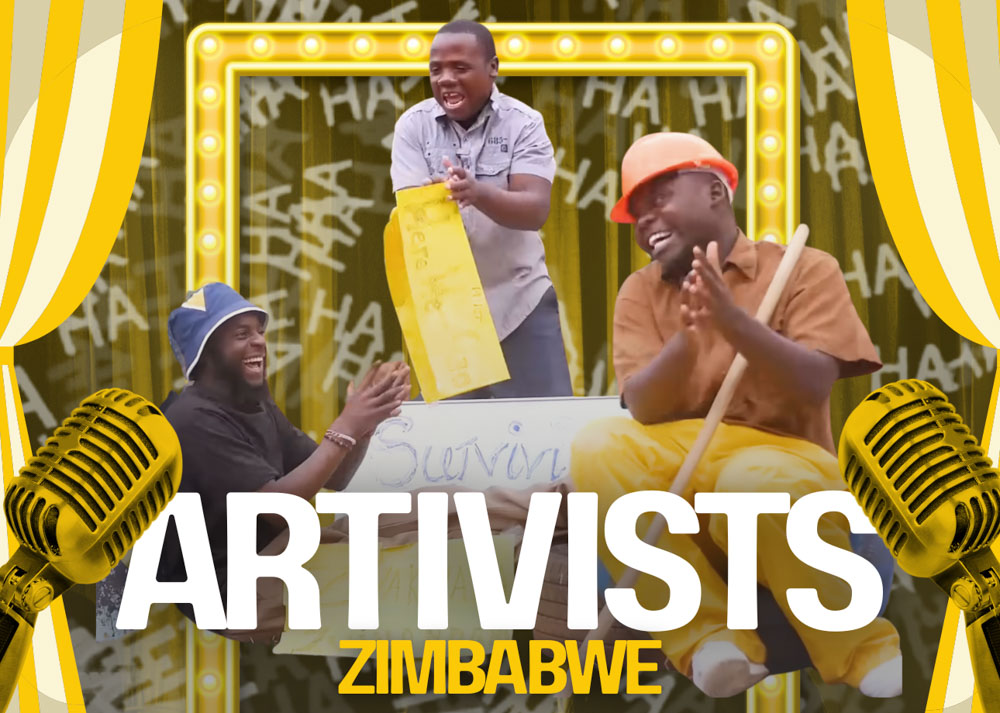
A daring contingent of young, tech-savvy content creators routinely battle censorship, arrests and worse to help increase awareness of Zimbabwe’s critical issues through humour. The wave is not confined to politics: the environment, economics and even religious beliefs are being questioned in a tsunami of YouTube, TikTok and other parody productions. But the ruling party ZANU PF, its militants and government are the butt of most jokes.
Among the most-followed examples is a weekly parody news bulletin The Week, by the YouTube show Magamba TV (57,9 K subscribers), that takes digs at corruption and service delivery decay with actors offering vivid, emotional illustrations of the issues. The parody news, said fans, often informs the public better about ruling party issues than the ruling party itself.
Most recently, Magamba’s take on the constitutional amendment bill that was signed into law in July and cements the rule of present leader Emerson Mnangagwa to 2030, overtook the dry and vague government summaries in established media; it even showed how there were political divisions around the bill, a fact carefully kept secret in official news. Australia-based comic Taffy The Man also offered his insights on the debate. His constitutional amendments show reached over 295,000 views.
“The alternative is state propaganda”
“The avenue to get independent news are these content creators,” said one fan, pointing out that the “alternative is state propaganda.” Another agreed, saying he used to follow local news outlets but has now shifted to skits. “Growing up, the news updates were always on what the government had done, and rarely about their failures, all in a serious way,” he says. “Today we have a wide range of information sources doing great work.” Yet another viewer commented that the culture of parody helps him cope: “These skits are a source of culture and relief in our hard, stressful life. It's easier on the soul to be informed whilst at the same time finding humour in the absurdities of current affairs.”
Head of Department of Communication and Media Studies at the University of Johannesburg, professor Admire Mare, says the digital age is enhancing old ways to air social grievances. “Since time immemorial, artists have used music, comedy, satire, cartoons and graffiti to comment on issues considered taboo and out of bounds. (…) content creators are (now) critical in terms of speaking truth to power and holding the powerful to account.”
Clips about state intimidation went viral
It is difficult to overstate the role played by the internet in the wave. The ruling ZANU-PF party could previously simply assure people that it enjoyed nation-wide support, since it controlled state media. But doing this is becoming an ever bigger challenge. Though government, for example, easily secured the votes needed for the constitutional amendment bill through its overwhelming majorities in both the National Assembly and the Senate, its declaration that “99,4 % of submissions in national consultations” supported it, was widely laughed at, with social media clips and statements about intimidation going viral.
Foreign-based shows like Taffy the Man’s (138,000 subscribers) and Comic Pastor (200,000+), based in Australia and the UK respectively, still added more power to the wave because of their relative freedom. But even locally-based satirists have spoofed ruling party militants beating down on unsuspecting people -often hapless citizens who have no idea what they have done wrong now.
Dissecting policy
The critical takes on social issues often go beyond mere protestations. One Magamba “The Week” episode, called “Is Zanu PF Reversing Land Reform?” dissects the patriotic-sounding agriculture ‘land reform’ policy launched by previous dictator Mugabe. The “land reform” purported to restore and stimulate black land ownership and farming, but in the end did little besides paying white farmers huge amounts from state coffers to abandon their farm enterprises. Highlighting how the ZANU PF government could not even pay its own civil servant salaries but dished out an unbudgeted US$3.5 billion payout to farmers for the expropriation of their land, the reportage featured two actors, a former white farmer and a “resettled” black farmer fighting over a repossessed piece of land. “How can the government pay you US$3.5 billion, when they can’t even finance healthcare,” the black farmer quips angrily.
Magamba’s fellow satirical programme Bustop TV (167,000 followers), in another skit, then portrayed a former white farmer’s child returning to their repossessed farm only to find the farm dilapidated and abandoned, invaded by artisanal gold miners. In the end, the two discuss the way forward, and how to work together, start farming and rebuild the industry.
“I realized I was portraying my day-to-day life”
Doing such internet-based sketches started as a way of amusement, with hopes for following, among unemployed youths, says Bustop TV’s prominent actor Samantha Kureya. Kureya was born in poverty, in 1986, six years after Zimbabwe’s independence from the UK in the Harare suburb of Mufakose, a place “where basic service delivery is a luxury, with water and electricity outages, raw sewage flowing on the streets and limited access to healthcare.” As a child, Kureya says, she “believed it was normal to live that way, but as I grew up, I understood it was wrong.”
The skits on social ills she started to produce with fellow performers of her generation gathered momentum, igniting conversations in her area about topics that were previously considered taboo. “While it was for fun, I realised that I was actually portraying my day-to-day way of life. People started to comment about these issues, such as garbage collection, and some clips went viral and even caused local authorities to act on them. “It was a revelation. I realised that service delivery was not a privilege but actually a right. Over time, we began to have impact, and authorities began to take notice of our voices.” They were always careful, however. “In Zimbabwe it is dangerous to name and shame a particular person, so we used satire to address sensitive issues.”
“Enemy of the state”
But being careful did not always safeguard Kureya from retaliation. In 2016, she was arrested and fined US$20 for her role in a skit in which she wore a police uniform on a charge of slander for portraying police harassment and brutality. In the episode, called “Order & Law: Special Unit”, a reporter denies complaints about police violence while, behind her, actors dressed as police officers whip people who, they say, said the word “government”, -this can, after all, only be critical. Three years later, in 2019, Kureya was abducted by masked gunmen, beaten, stripped naked and made to drink sewage water before being released. “I wouldn’t want to revisit it, the trauma is still there”, Kureya says.
Other action taken against her and Bustop, though less horrific, also still impact on the work she and her colleagues do. “It remains very risky. I have received many threats and have been barred from attending some national events. We have suffered outright censorship, and some corporates have been cautioned not to work with Bustop TV, because they would be deemed an “enemy of the state.” But despite these challenges, I feel my community and family deserve better and I will keep on speaking and hope for a better future.”
Satirical opinion writer Faith Zaba has also felt the might of the authorities she takes on. Her arrest in 2025 for a piece titled “when you become a mafia state” in which she jokingly celebrated the end of President Mnangagwa’s tenure as chair of the Southern African Development Community SADC, resulted in her spending a year in jail.
The article “undermined the authority of the president”
Her article had, again jokingly, suggested the possibility that the ZANU PF government, through its SADC chairmanship, somehow helped fellow autocratic governments in the region commit elections fraud. “When you have become a mafia state, and are known to arm fellow criminals from around the globe with your diplomatic passports, it becomes very hard to stop your people from believing just anything,” it said. Referring specifically to the 2025 elections in Mozambique, widely perceived to be fraudulent, but endorsed by the SADC, Zaba also noted that “Mozambique stands out as our owner’s trophy when it comes to successful poll rigging.” The piece led to her arrest by the authorities for “undermining or insulting the authority of the president”. Zaba was jailed, with bail delayed and denied for as long as a year. Only by the end of last June, the charges were thrown out by Zimbabwe’s High Court.
Back to “Mugabe”
Examples of recent repression have caused cartoonist Edward Kangai, whose drawings show political elite figures feasting, with bulging stomachs and purchasing luxury trinkets while the famished citizenry swim in abject poverty, to operate anonymously. Kangai recalls starting nine years ago with high hopes, during a wave of free expression in Zimbabwe that accompanied the ouster of the country’s sole ruler since independence, Robert Mugabe, in 2017. It was a time of constant highlights and exposés, memes, and cartoons, he says. “People wanted change. This was an opportunity for different creatives to showcase their concerns on human rights issues. But then the shooting happened in 2018.”
Post-elections violence that year, in which six people were shot dead by security forces, was unleashed by Mugabe’s successor -now still president- Emerson Mnangagwa, of the same ZANU PF party. The security force clampdown was the new ruler’s response to protests by marchers who saw ZANU PF’s win after Mugabe’s departure as fraudulent. “We have almost returned to the Mugabe era”, Kangai says. “But I am still enjoying my work and somehow getting fame from it. I follow current political trends and debates, and what the people are saying and I work on that to amplify freedom of expression.” Referring to the fact that the name ‘Kangai’ is a pseudonym, he explains that he prefers “to remain anonymous, due to the sensitivity.”
Filmmaker and social justice-themed content creator Dexter Fundire, who has inter alia worked with Magamba TV, agrees that the pressure is often a lot to bear and confirms that ruling party pressure has led to loss of income for him and his colleagues, too. “At Magamba TV, we could not get our advertisements out on local radio, or local news or TV networks would not screen our films.” But, he says, the artistic sector itself provides much-needed injections of hope. In March this year, Fundire received a National Arts Merit Award for his artisanal miners’ series, done for Magamba, called Magweja (illegal miners). The series shows countrywide corruption, bribery, environmental destruction and smuggling overseen by untouchable, wealthy, protagonists.
Fundire also directs the annual Bokola Film Festival, which promotes marginalised communities. “What always drove me is realising what privilege is and what it isn’t. I was able to travel and see how the world really works and not a lot of people are privileged to have the opportunities I have had. In places where we can check accountability for the status quo, I think it is very important to do so.”
“Properganda” mocks the habit of giving out cars
Besides the digital work, physical stand-up that laughs at ‘big men’, is also still a much-loved medium for Zimbabweans. The most famous of the current set, and increasingly popular, is King Kandoro, who tours not only Zimbabwe, but also other African countries and even Europe with his ‘Properganda’ show (misspelling intentional), which offers a comical view of social ills on both continents. In his recent State of the Nation Comedy Special, which garnered 255 K views, Kandoro had audiences in stitches proclaiming that the ruling party was simply “unstoppable: it operates at a level of power where you can see something happening, but you can’t do something about it.” Kandoro also mocks the habit of political protagonists who receive and dish out cars in acts of patronage in Zimbabwe, saying that he simply “cannot keep up with the rate” of cars being given away.
It is perhaps because of his wildly increasing popularity -his State of the Nation show in December 2025 sold out, attracting 4,000 people- that Kandoro still escapes state sanction. One admirer says he remembers “attending one of his shows in Johannesburg a few years ago. There were a few people, a hundred at most. I never thought he would be this successful filling up venues.”
Bribery
The state’s response to comedians who boast large popularity has included attempts at bribery on at least one occasion. Leroy Tadiwanashe, known as Comic Elder, who boasts close to 900,000 followers on TikTok was last year awarded a car by the president at the National Youth Symposium, where he was also recognised as “among 20 outstanding youths excelling in their respective fields.” Though Comic Elder’s comedy has not heavily focused on the kind of satire that could be perceived as “undermining” the state, the award was seen by some as an enticement to start supporting state propaganda.
An online piece by government critic Ruben Mbofana stated that such gifts to celebrities “reveal desperation, not popularity”. “Let us be honest”, he wrote. “No amount of luxury cars handed to a few selected comedians or musicians will convince the millions of suffering Zimbabwean youths that their reality has changed. That a comedian or musician of national repute cannot even afford a decent car in a normal economy speaks volumes about the state of disempowerment that defines Zimbabwe’s youth.”
The shows reach a sizeable contingent of urban youth
But whether bribery or retaliation by government: such attempts seem to be doing little to stop the wave of critical content or the growing size of its following. While rural areas remain underserviced, the country’s 40% internet cover reaches most towns and cities, where 2,5 to 3 million urban and internet-savvy youth between the ages of 12 and 35 live. When we added up all following of the “artivists” mentioned in this story we arrived at a staggering figure of 2,38 million, which seems to indicate that almost all ‘Gen Z’ youth in urban areas are fans. This would however be an exaggerated estimate, since the same fans will follow the same accounts across platforms. Nevertheless, Comic Pastor’s 918 K followers on Facebook alone amount to about a third of this demographic, and a 6th of Zimbabwe’s 6 million internet users.
Based on AfroBarometer’s 2021 Zimbabwe social media survey which showed that 4 out of 10 Zimbabweans rely for news on social media, where irreverence and satire abound, an estimate of 1 million satire and comedy followers may still be on the low side.
Class solidarity
It is difficult to predict whether this contingent will subvert the status quo of one-party-rule in Zimbabwe any time soon, but observers note that about 65% of those aged 18-25 and 86% of those aged 26-35 in Zimbabwe are now registered to vote. And at least one avid observer has taken the satirical content he follows already to be akin to a revolution: “Class consciousness and class solidarity is necessary in this day and age”, he said, speaking about the fandom.
See all the instalments in this Transnational Investigation here
Africa | Artivists
Nigeria | Undermining the political class
Cameroon | Dents in the dictatorship
Malawi | Presidents of the poor
Call to Action
ZAM works towards a new equal relationship between Africa and Europe. Contribute to our mission by donating.