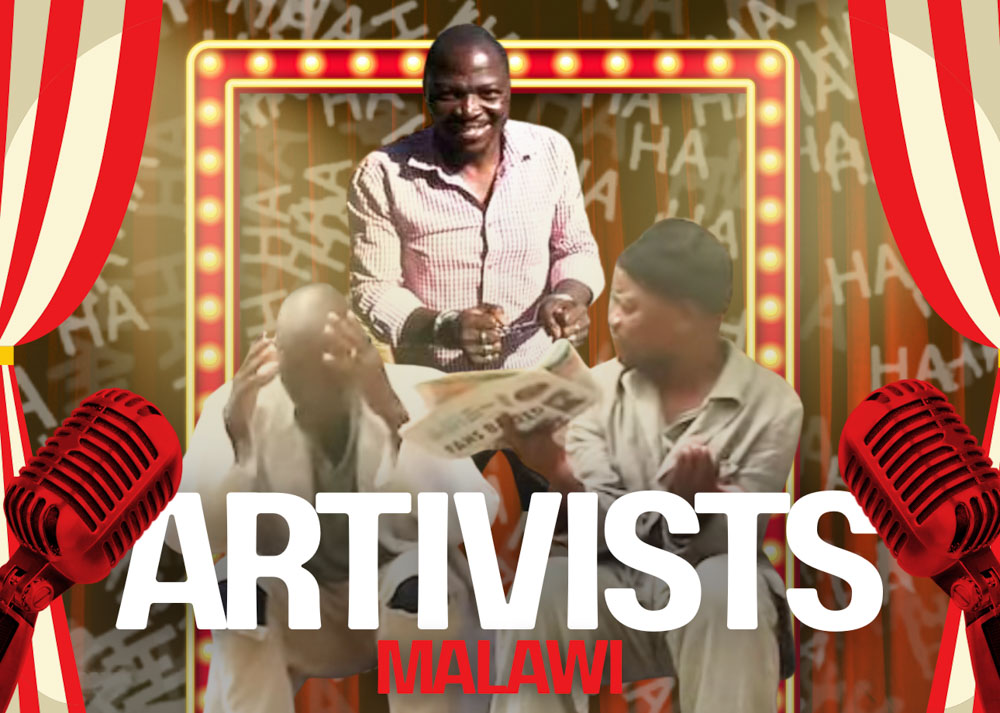
Two comedians, also anti-corruption activists, have served in Malawi's government. One quit first, then the vice president who brought him in died in a much-investigated plane crash, and the other, who had replaced the vice president, quit politics after his tenure. But still, the roar for change is swelling among the youth. Josephine Chinele explores the role comedy, especially on social media, plays in undermining the ruling political class in Malawi.
Malawi is yet to find closure following the sudden demise of its vice president, Saulos Chilima, and eight others in a plane crash on 10 June 2024. Official commission of inquiry findings have been disputed; alternative versions of the tragedy continue to resurface across communities, and a second commission of inquiry is underway. But, amidst the grief and political uncertainty, the circumstances leading to the crash have solidified the grassroots reach of those who laugh at, mock, and at times eviscerate the ruling political elite. Principally among them is comedian-annex-activist-annex-politician Bon Kalindo, nicknamed the "President of the Poor."
Stark warnings
For months before the tragedy, Kalindo had been using his social media and network of highly active WhatsApp groups to issue stark warnings to anti-corruption-minded Chilima, who, he insisted, was ruffling too many feathers and should quit the ruling coalition, called the Tonse Alliance, or head for doom. In a Times Television interview on 6 January 2024, Kalindo publicly appealed to Chilima to resign: "If he feels he can govern this country (alone), he needs to take action now, or else he is finished."
"I never used to believe him," recalls a Blantyre-based comedy fan who goes by the name of Sosten*. "I thought Kalindo was only frustrated because he wasn't appointed to a ministerial position (when he was a politician). Until Chilima's plane crash."
“Winiko” mocks politicians who use big words to confuse the public
Today, Kalindo’s 15-to-20-minute daily voice notes are a staple of Malawian digital political discourse, routinely marked with WhatsApp’s “forwarded many times” tag. His now-famous dramatic comedic persona, ‘Winiko’, a playful, fast-talking character, represents the struggles, wit, and political mistrust of the ordinary Malawian. Using Chichewa street vernacular mixed with old sayings, idioms, and proverbs, Winiko addresses serious issues such as corruption and difficult economic situations in a hilarious way, often mispronouncing or misapplying grand economic and political terms to mock the habit of politicians "using big words to confuse the public."
Reflecting the mood of the marketplace, the minibus terminal, and the village square, he captures a reality where people use humour to survive, but are always just one bad policy away from taking to the streets. Winiko illustrates the daily frustrations of Malawians through his use of everyday images, such as the empty cooking pot, the lack of fertilizer, or the struggle to buy basic necessities from local markets. Whether holding court in a sharp white suit, marching through the streets in an activist's T-shirt, or stripping down to his underwear for a naked protest, Kalindo's wardrobe is as unpredictable and radical as his politics.
Political struggles
Theatrical performance and social activism have always been joined hallmarks of Kalindo’s public appearances. Having won a parliamentary seat in 2014, Kalindo unleashed his first major street protest two years later, drawing attention to the horrific wave of killings of people with albinism at the time. Publicly denouncing the scourge, which was rumoured to be condoned by politicians and law enforcement officials who, it was said, also believed that the body parts of people with albinism, when used in witchcraft rituals, would bring wealth and power, Kalindo organised a ‘naked demonstration’ where he and fellow protestors marched through the streets in their underwear.
The protests against albino killings angered his own party
It was the first ever time that a politician had taken to the streets on this issue, which was normally only whispered about behind closed doors. The action angered even fellow politicians in his own Democratic Progressive Party (DPP), who felt that what Kalindo had done was a public relations nightmare, akin to betrayal, since it highlighted the government's inability to protect vulnerable people with albinism, embarrassing the administration internationally. Instead of answering his criticisms, the DPP went on the defensive, weaponising cultural taboos around public nudity to deflect from their political shortcomings. In an interview with ZAM, Kalindo admitted that he was stunned by this at the time. "I had expected a lot of support from fellow parliamentarians and my party, the ruling party then, as the killing of people with albinism was an issue of national interest."
A full break with the DPP would follow three years later, after Kalindo’s activism had made him a frequent target for police arrests. In the turbulent months ahead of the 2019 elections, Kalindo shifted towards supporting a new movement by then opposition leader, later vice president, Saulos Chilima, the same Chilima who would later die in a plane crash. A vicious assault by the DPP’s youth wing in Mulanje on Kalindo and others in January 2019 truly solidified the move. From then on, the firebrand campaigned for Chilima’s new United Transformation Movement, which was working to bring their candidate, later President Lazarus Chakwera, to power on an anti-corruption ticket, with Chilima as VP.
A wheelbarrow full of Kwacha
It would take Kalindo another two years to realise that Malawi’s political class was not ready to address the issues that mattered to ordinary citizens. By 2021, he had walked away from party politics entirely, citing a complete failure to address the skyrocketing cost of living. "I am taking this opportunity to publicly apologise for campaigning and making Malawians have faith in a system that has broken their livelihoods in so short a time," he announced at a press briefing.
“If you see one of the promised jobs, please catch it”
Since then, acting under the "Malawi First" movement he founded, "Winiko" has utilised his digital presence and WhatsApp forums (each packed to their 1,700-member limit) to disseminate his voice notes and mobilise nationwide demonstrations over fuel shortages, toll gate fees, and systemic corruption. Mocking the Tonse government's "one million jobs" campaign promise, he was filmed physically searching for the promised employment under rocks, inside empty pots, and in people's pockets, yelling in Chichewa: "I am looking for the remaining 999,000 jobs! If you see one walking on the road in Blantyre, please catch it and bring it to Capitol Hill!" When the Malawi Kwacha was massively devalued in 2023, he staged a performance where he treated a Kwacha note like a dying patient in a hospital bed. Holding up the note and feeling its pulse, he yelled at the doctors, representing the Ministry of Finance: "The patient is shrinking! Tomorrow we will need a wheelbarrow full of Kwacha to buy a piece of sugarcane!"
Within all this, prominently, were the warnings to Chilima to quit before it was too late.
Ministry of Potholes
Remarkably, the politician who replaced the deceased Chilima as vice president after the plane crash in 2024 had also earned his stripes as a comedian. Then new, now ex-Vice President Michael Usi once worked together with Bon Kalindo in theatre circles and also rose to fame through a theatrical persona, called Manganya in his case. Like Winiko, Manganya used a semblance of ignorance or foolishness to deliver critiques on governance, economic mismanagement, and social decay. When the government introduced a "zero deficit budget" that heavily taxed everyday household goods, the Manganya persona exulted, looking straight into the camera: "Our leaders have achieved a miracle. They have successfully managed to tax the smoke coming out of our chimneys. Soon, if you breathe too deeply in Lilongwe, you will receive a bill from the Malawi Revenue Authority for consuming premium state air."
“Soon, you will receive a tax bill for consuming premium state air”
On another occasion, mocking the bloated size of Malawian cabinets, where politicians are routinely handed massive ministerial portfolios as political favours, he announced a new "Ministry of Potholes", saying: "Our government is so smart. They don't fix the road. Instead, they create a Ministry of Potholes, appoint a Minister, give him a Land Cruiser, three bodyguards, and a fuel allowance so he can drive around and formally count how many holes we have."
Usi crossed the bridge from political theatre into actual state politics, campaigning as Chilima’s running mate in 2019, the same year in which Kalindo completed his term as MP and was preparing to join the board of the state housing agency (a position that Kalindo would quit in 2021, when house rentals reached sky-high levels: a development that contributed to his announcement that same year that he was leaving politics and government for good).
Usi stayed on as vice president after the 2024 plane crash that killed Chilima, establishing his own party, Okudya zake alibe mlandu ("those who eat only what is theirs have no guilt"), to contest the 2025 elections. However, after the party failed to gain significant wins, Usi also stepped back, but he remains an influential and respected figure as a playwright, director, and creative advocate.
State intimidation
While former President Chakwera took historic decisions to bring Malawi’s two best-known satirists into government, the response from the system and political elite class has, on the whole, been less accommodating. Between 2016 and 2026, Kalindo has been arrested 15 times. In 2019 alone, he was detained three times for allegedly insulting then-President Peter Mutharika. He was locked up again in August and September 2023 for leading anti-government demonstrations held under the rallying cry of "Malawi Sali Bho" (Malawi isn’t fine), in which tens of thousands participated. Nevertheless, the satirical onslaught, the demonstrations, and the masses of followers also forced political compromises: in 2021, the government was pushed to slash newly introduced tollgate fees by up to 42 per cent.
Meanwhile, the state still seems to be thrashing around for ways to deal with Kalindo. Dramatic arrests, bail applications, immediate releases, and subsequent re-arrests are by now an eternal cycle, a set of activities his legal team defines as political performance rather than a legitimate judicial process. His lawyer, Gilbert Khonyongwa, feels that "the State (generally) appears willing to go to great lengths to silence criticism, regardless of whether that criticism is expressed through comedic satire, political commentary, or the exercise of free speech."
Each arrest has served as a marketing campaign
In the case of Kalindo, Khonyongwa explains, the government's strategy has seemingly been fashioned not to "secure convictions" — since the success rate in these prosecutions has been zero — but "rather to intimidate, inconvenience, and silence a prominent government critic. It is difficult to avoid the conclusion that these legal actions served an immediate political purpose rather than a genuine pursuit of justice."
Yet, each arrest has served as a high-visibility marketing campaign for Kalindo's digital platforms. National Police Spokesperson Lael Chimtembo declines to comment on the legal strategy or specific charges behind the state's continuous legal actions against the activist, saying that "the majority of the matters you are asking [about] are still pending before courts."
Human Rights Defenders Coalition (HRDC) Chairperson Michael Kaiyatsa points out that state authorities are unequipped to respond effectively to comedy and satire. "Satire is difficult for government to deal with because it uses humour to communicate serious issues. People may ignore a political speech, but they easily remember a joke. Satire also spreads quickly through social media and WhatsApp. When government reacts harshly to jokes or mockery, they often make the satirist more popular and give more attention to the issues being raised." He adds that, even if Kalindo’s work has not actually changed policies or laws, "it gives ordinary Malawians a conceptual vocabulary to talk about complex, institutional issues such as poverty, corruption, and poor governance."
“If there are cowards in this world, it’s politicians”
Kalindo himself remains unfazed, calling the politicians who fear and retaliate simply "cowards." "If there are cowards in this world, it’s politicians. Towards the 2025 elections, they summoned me, only to interrogate why I call myself the president of the poor. They asked if this implied that I had ambitions to become a president myself." The fear of others is, he says, "why they don’t arrest each other for corruption."
Digital divide
Political scientist at Blantyre International University Chimwemwe Tsitsi believes that satire has the potential to influence public discourse and drive change, but also feels that much more needs to be done. "It would also help if critics engaged politicians directly on the issues they raise," he says, adding that the impact of satire, mostly communicated via the internet, is also still constrained by the digital divide. "It can have an impact on how people think about politics and make political decisions, mainly among urban youth, who follow social media. But most rural youths don't have access to the internet."
The fact of Malawi’s urban-rural and generational digital divide also worries the HRDC’s Michael Kaiyatsa, who points out that differences in "digital participation could (even) deepen existing inequalities." Kaiyatsa hopes that, through "international support and deliberate investments in digital infrastructure, affordable internet access, and digital literacy programmes, technology can become an inclusive tool that amplifies the voices of both urban and rural citizens. Digital spaces could then complement, rather than replace, traditional forms of civic engagement so that no Malawian is left behind in the governance process."
Might a better-governed society for now only emerge in highly connected urban spaces, similar to trends observed in Zimbabwe or South Africa, while the rest of Malawi’s disconnected interior continues to suffer? "There may be a grassroots way around this emerging, though," ponders Tsitsi. "Many trade centres in rural areas are now frequented by the youth using the internet."
“If I was youthful, I would follow him to the demos”
Sixty-three-year-old Theresa* from Blantyre is certainly supportive of the changes, saying she really likes Kalindo. "He is like that (still the same) even though he has been arrested and tortured." Theresa actively engages in four separate political WhatsApp groups where Kalindo’s audio files are debated daily. "If these politicians listened to him, they wouldn’t be making blunders," she says, adding: "If I was youthful, I would also follow him to the demos, but I leave that to the younger generation."
Two sides of the same coin
Malawi comedians have also had an impact internationally, especially in the West, where the likes of Daliso Chaponda mock racism, African stereotypes, and global inequality, pulling apart the hypocrisy of international powers, Western privilege, and the lingering ghosts of colonialism. Their content differs substantially from Malawi’s localised, vernacular satire, which targets immediate, everyday domestic failures, policy blunders, and economic hardships. The subjects do overlap, though. Says Michael Kaiyatsa: "Diaspora comedians tackle global colonial legacies, while Winiko targets everyday domestic hardships. These voices are two sides of the same coin. We need both to question international systems and hold our own leaders accountable."
*Names changed for safety reasons
See all the instalments in this Transnational Investigation here
Africa | Artivists
Zimbabwe | The parody tsunami
Cameroon | Dents in the dictatorship
Nigeria | Undermining the political class
Call to Action
ZAM works towards a new equal relationship between Africa and Europe. Contribute to our mission by donating.