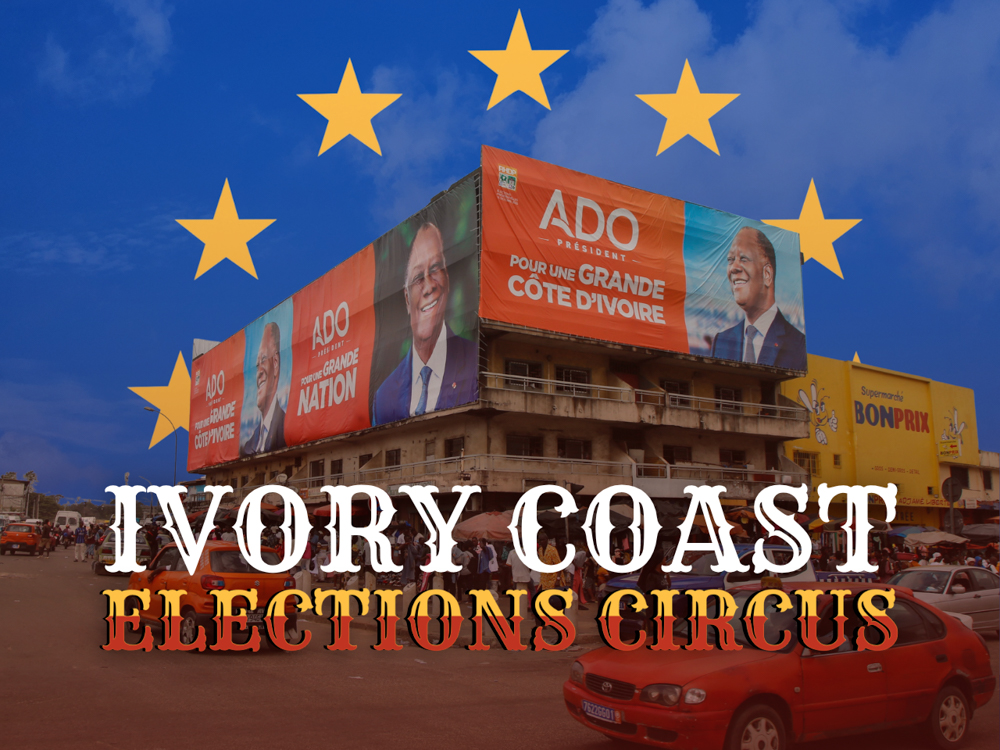
It is March 2025, seven months before the much-anticipated presidential elections. In the brightly lit conference room of the Plateau Mövenpick Hotel in Abidjan, government representatives, diplomats, political party leaders, religious figures, electoral commission officials, and civil society representatives gather to loud applause. The EU delegation to Ivory Coast has just announced a €7 million package to support violence-free and transparent elections through its programme, “Tous engagés #ElectionsSansGbangban”.
This loosely translates as “All together for an election without trouble.”
The previous election cycle in 2020 resulted in 85 deaths, hundreds of injuries, and thousands of displaced people. This time will be different.
« The trainings and the manuals were just for show »
Except, in the end, it was not. “We were told the programme would change everything […] but it was the same as before. The trainings and the manuals were just for show. And when violence broke out, we were left on our own,” recalls Abidjan civil society activist Franck Ano.
The 2025 election would again see violence in clashes between the state, which deployed 44,000 police and riot officers, and a frustrated population. After the country's Constitutional Council barred several opposition leaders from participating -clearing the way for President Alassane Ouattara's bid for a new term- and after the Abidjan Prosecutor's Office arrested some on ‘terrorism’ charges, many sections of civil society had turned anti-vote and urged boycotts. In several localities, Electoral Commission offices were set on fire, amid reports of attacks against administrative authorities and police officers. Confrontations between pro- and anti-vote groups took place in major cities. Outright killings were fewer than in 2020, but 11 people still died, including a Gendarmerie officer, and 71 people were injured. Police made 1,658 arrests, followed by nearly 400 prison sentences. Several hundred jailed civil society activists are still awaiting trial.
Testing ground
For over two decades, Ivory Coast has served as a testing ground for international democracy aid, especially in the electoral sector. Since at least 2010, the European Union has invested tens of millions of euros in the country, supporting initiatives ranging from biometric voter registration to peace messaging, civic education, and electoral security. Every time, the architects of these interventions—EU officials, UNDP managers, and Ivorian state technocrats—present their efforts as crucial to preventing conflict and advancing democracy. However, the main flaws have always continued.
The question arises as to whether Western democracy support in Ivory Coast is simply ineffective. Is the country incorrigible? Or could this support be undermining genuine democratic progress? It is difficult to answer these questions, as much of the necessary information is unavailable. What seems clear, however, is that most of the disbursed millions go to the Ivorian state.
Could the support be undermining genuine democratic progress?
For the 2020 elections, the EU contributed €1.5 million through the UNDP-managed Ivory Coast Electoral Cycle Support Project (PACE), a basket fund also supported by France and Germany individually, as well as Japan and other donors. PACE’s official objectives in 2020 were to enhance the capacity of the Independent Electoral Commission (CEI), promote peaceful elections, strengthen civic education, and encourage the participation of women and youth. Attempting to determine how the total PACE budget of €8 million was spent is an uphill task, but the report confirms in several instances that the CEI, the Independent Electoral Commission, received the lion’s share of resources for “institutional capacity building.” These include:
• Purchase of computers and accessories (500 computers, 500 printers, etc.)
• Production of training manuals (more than 150,000 copies)
• Construction of 78 container units
• Support for communication (website, media)
• Per diems for 3,906 local “focal points”.
The exact amount allocated by PACE to the CEI remains hidden, as does the amount disbursed to civil society organisations. Although the evaluation emphasises that CSOs played a “major role” in the implementation of the project, particularly in “awareness-raising, communication, and civic education”, the report contains no details of who received what funds or for what purpose.
Black box
« For details, please contact Brussels »
By channelling its electoral funding through organisations such as the UNDP basket fund mechanism, the EU tries to distance itself from accusations of foreign interference, says sociologist Dr Ekian N’Goran, who lectures on global governance at Félix Houphouët-Boigny University in Abidjan. “In theory, this is meant to ensure accountability and transparency, but in practice, it functions as a black box. You dare request a breakdown of EU-funded projects run by UNDP and other partner organisations? They are accountable only to their donors.” With a light smile, he adds: “For details, please contact Brussels.”
A suspended interview
Trying to find more information from the EU delegation in Ivory Coast about who and what exactly it has funded in the past two elections is unsuccessful. Emailed inquiries go unanswered, despite multiple follow-ups and phone calls to the delegation’s Abidjan press office. When I finally manage to reach an EU official by phone, the conversation briefly seems productive, and an appointment for the next day for an in-person interview is made for 10:00 am. However, when I arrive at EU headquarters at 9.45 am that day and text the official I had spoken to, telling her I am here, there is no response. Checking my phone for missed calls, I note an email — the time indicates it was sent when I was on my way there — saying that my request had been “forwarded” to another EU official in the Cooperation Section. There is no follow-up.
Perpetual failures
N’Goran feels that the same system insulates donors from the failures they help perpetuate. “We often hear that EU money is stolen or wasted by corrupt officials, but these are not (incidences of) corruption. It’s the structure. The real scandal is that the funding structure itself is set up to favour state institutions that are, most of the time, part of the problem. Independent actors cannot access meaningful support. The EU’s focus on technical assistance and capacity-building for state actors, rather than direct support for independent civil society, has the effect of reinforcing existing power structures and marginalising genuine democratic voices.”
« The funding structure is set up to favour state institutions »
The prominent role of civil society organisations and independent media working for democracy in Ivory Coast is emphasised in a 2018 EU-financed mapping study on civil society organisations in the country. The report recognises that “many Ivorian civil society organisations are doing remarkable work and are (executing) pioneering experiments with tangible results.” It also admits that “some (state) structures, which are sometimes better known to public authorities and funding bodies, are not necessarily the most competent ones.”
But eight years later, the EU is still not helping these competent CSOs to act for democracy in Ivory Coast. In a modest office in Yopougon, civil rights advocate Reine Atta, in her early thirties, sifts through reports of violence and voter intimidation from the last election, including many cases of arrested and harassed fellow activists. With her exhaustion visible in the dark circles under her eyes and her voice occasionally faltering, she explains that she will continue to do what she does, no matter what. “There is a pervasive sense of political stagnation, as though the nation were locked in a cycle of repetition. But we must not succumb to fatalism. Our work is far from over. We owe it to the next generation to keep fighting.”
Asked about EU support for elections, intended to build democracy, she sighs. “Every election, it’s the same story. When it comes to allocating funds to partner organisations working on the ground, the money barely reaches those fighting for real change. We are left out.”
A small slice of the pie
Similar despair is expressed by prominent civil society leader Drissa Soulama. Though his umbrella organisation FOSCAO (Forum de la Société Civile de l’Afrique de l’Ouest) brings together 32 civil society organisations, it has received only €20,000 to “ensure their greater involvement in public policies” in the context of the 2025 elections. Soulama explains that this is a drop in the ocean compared to the millions allocated to state entities. “They [the EU] fund the Independent Electoral Commission, which is independent in name only, which means they are funding the government, which is not accountable. Meanwhile, organisations like ours, which monitor abuses and document fraud, have to struggle just to get a small slice of the pie.”
Soulema’s FOSCAO has still been luckier than the country’s largest national NGO platform, CSCI (Convention de la Société Civile Ivoirienne), which counts more than 190 members but was allocated only the equivalent of €6,000 by the European Union to undertake initiatives in support of peaceful elections. Coordinator Fousseni Tall says it was “unfortunate” that the EU did not recognise the CSCI as an umbrella organisation. “This 4 million CFA, the €6,000, was the smallest amount they could possibly allocate under their projects, and that is the amount that was allocated to us.”
State agents held a workshop
Sarah Kadio, 22, an activist and student at Abidjan’s Nangui Abrogoua University, summarises the mood among our country’s Generation Z: “State agents held a workshop at our university. There were banners, snacks, and speeches […] But real change comes from those on the ground, not from these PR stunts. The real democracy builders are left without resources while the regime and its agents get richer.”
Dr Ekian is not surprised that EU funding strengthens an oppressive state rather than democrats fighting for change. “The EU’s overriding priority is stability,” he says. “(What comes after) genuine democratic change is unpredictable. The state, even if flawed, is a partner the EU can work with.” Reina Atta puts it more sharply: “They say they want democracy. But what they really want is a government that keeps the cocoa exports flowing and migrants out of Europe. We are on our own.”
« What the EU really wants is a government that keeps the cocoa exports flowing and the migrants out of Europe »
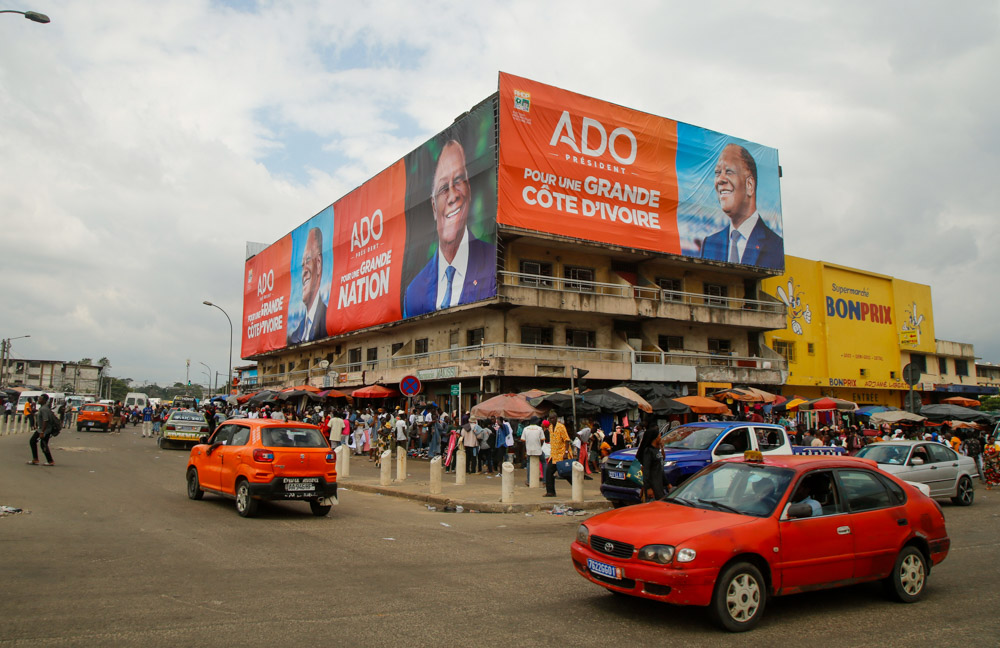
As Ivorians prepare for the next electoral contest in 2030, the posters and banners may be new, but the script, many interviewees fear, will remain unchanged. EU millions will be spent. Workshops will be held. Violence will persist. In the words of Abidjan-based consultant Léon Kouamé: “If the EU truly wants to support democracy in Ivory Coast, it must restructure its funding mechanisms and support civil society, grassroots organisations, and independent journalists. Until then, its support will be nothing more than a mirage — a shadow over our democracy.”
See all the instalments in this Transnational Investigation here
Elections circus
Nigeria | Technology 0, politicians 1
Uganda | A humanitarian veneer
Zambia | Restraint and fear
Kenya | Sound and fury
Jimmy Kitiro | When aid helps autocracy
Call to Action
ZAM works towards a new equal relationship between Africa and Europe. Contribute to our mission by donating.