
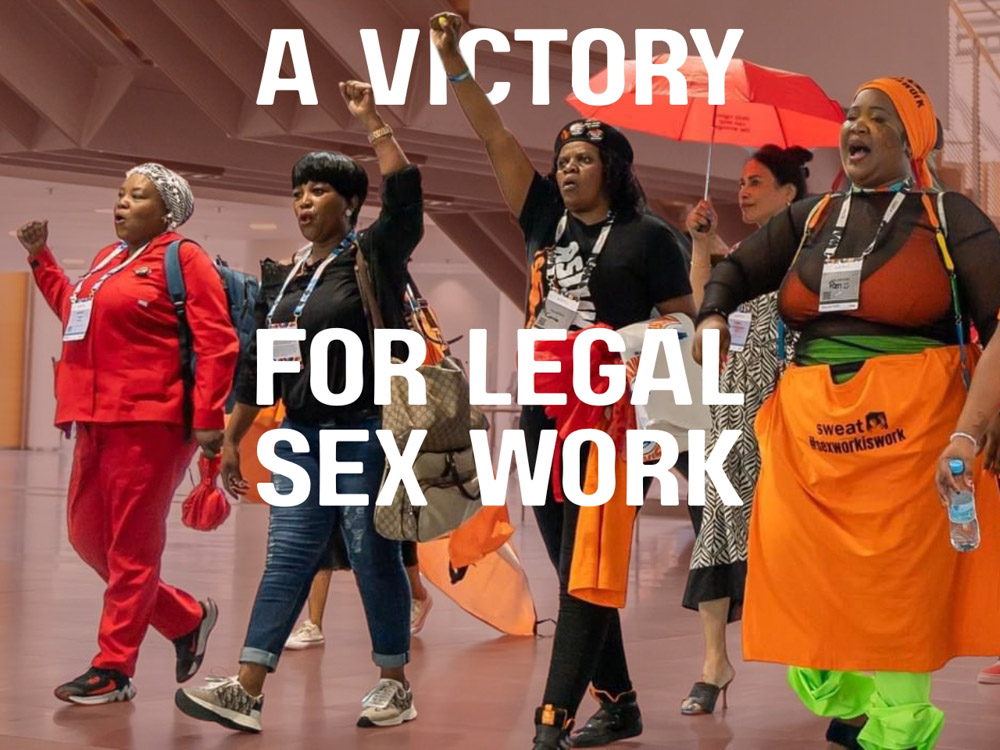
South Africa’s post-apartheid Constitution, which unapologetically centres human equality and rights for all, is now paving the way for the decriminalisation of sex work in the country.
A case in a courtroom in Cape Town this October may augur the beginning of the end of women in sex work’s nights of anguish, where harassment and abuse, including from law enforcement, were always looming around the corner.
At the centre of the legal battle is a woman identified only as S.H. alongside the Sex Worker Education and Advocacy Taskforce, better known as SWEAT, the organisation that has spent more than thirty years fighting for the rights, safety and dignity of sex workers in South Africa.
SWEAT’s constitutional challenge launched in the Western Cape High Court could overturn apartheid-era criminal laws that continue to govern sex work in democratic South Africa. At the same time, and based on the same Constitution, the Department of Justice says it is preparing new legislation that would formally decriminalise sex work.
Yet just as the movement approaches what could be its defining victory, a devastating global funding crisis threatens to cripple the very organisations carrying the fight, while worldwide, a conservative backlash threatens to roll back the tide for women who rely on sex work either as a professional choice or simply to make ends meet. (A ZAM investigation in 2019 showed that nearly two-thirds of women in Africa’s urban and rural communities admitted to selling sex to either feed their kids, fund care for ailing family members, pay school fees or simply travel.)
A movement born in the AIDS crisis
SWEAT was founded in Cape Town in 1994 at a time when South Africa was entering democracy while simultaneously confronting the AIDS epidemic.
Sex workers occupied a dangerous position within both crises. They faced criminalisation, police violence and social stigma, while also carrying disproportionate vulnerability to HIV infection because criminalisation pushed them underground and away from healthcare.
Over the next three decades, SWEAT became one of the continent’s most influential sex worker rights organisations. It helped establish the African Sex Worker Alliance, now based in Kenya, and Sisonke, South Africa’s national movement of sex workers.
Criminalisation, SWEAT argued, did not eliminate sex work
Its activism increasingly drew connections between public health and human rights. Criminalisation, SWEAT argued, did not eliminate sex work. It merely made sex workers more vulnerable to violence, extortion, HIV and exploitation.
Those arguments, at the time, were echoed globally. In the Netherlands, where sex work was formally legalised in 2000, policymakers increasingly framed sex worker protection as a labour and public health issue rather than a criminal one. Dutch HIV organisations such as Aidsfonds supported international harm reduction approaches grounded in evidence rather than morality. For activists inside SWEAT, the Dutch experience demonstrated that treating sex workers as rights-bearing citizens rather than criminals could improve access to healthcare and reduce harm.
Meanwhile, South African sex workers continued to work under the constant threat of arrest, arbitrary detention, and other abuse.
The constitutional fight
SWEAT and S.H. launched a constitutional challenge against provisions of the Sexual Offences Act of 1957 and the Criminal Law (Sexual Offences and Related Matters) Amendment Act of 2007 in May 2024, arguing that the criminalisation of adult consensual sex work violates constitutional rights to dignity, equality, privacy, safety and healthcare.
The case immediately became one of the most significant rights-based legal battles in post-apartheid South Africa.Dozens of organisations joined as amici curiae, or friends of the court, in support of SWEAT’s case. These included Sonke Gender Justice, the Treatment Action Campaign, Amnesty International, Human Rights Watch, the Women’s Legal Centre, the South African Human Rights Commission and the University of Pretoria’s Centre for Human Rights.
But the opposition has mobilised too. Religious organisations, anti-prostitution lobby groups and international campaigners have entered the legal process arguing that criminalisation should remain. Ironically, the counter is now also resonating in the West, where a broader resurgence of nationalist conservatism has intensified attacks on women’s autonomy, reproductive rights, LGBTQIA+ protections, migration and progressive constitutionalism.
Some progressives have joined the anti-sex-work fray
Even some self-identified progressives and feminists in the West have joined the anti-sex-work fray, arguing that sex work “degrades” all women. Part of this wave has also been inspired by concern about migration, specifically its human smuggling component. Anti-human trafficking organisations have profiled themselves as set to “rescue” women, who, they believed, had only left their countries of origin under the influence of ruthless pimps and were now “forced” into sex work in Western countries, ignoring a large and growing body of work that shows that women, like those interviewed by ZAM in 2019, very often opt to sell sex to fund all kinds of necessities, including travel.
In this worldwide debate, some, hesitating to criminalise women, have advocated for the so-called Nordic Model, which criminalises the buying of sex rather than its sale. SWEAT and other activists, however, reject that model, arguing that criminalising clients still drives the industry underground, forcing workers into isolated spaces where violence becomes harder to report and negotiate.
Under pressure
More generally, South African activists warn that the country’s Constitution, once celebrated globally as one of the most progressive democratic frameworks in the world, faces mounting pressure from anti-rights movements determined to reverse gains secured after apartheid. Debates over sex work, abortion and queer rights have become part of a much larger ideological struggle, in SA and worldwide, over the meaning of dignity, bodily autonomy and equality under the law.
For SWEAT, the constitutional challenge is therefore about far more than sex work. It is about whether South Africa’s democratic institutions can still protect politically unpopular communities when reactionary politics are once again gaining ground globally.
A significant material challenge to this fight is posed by the retreat of governments and donors across Europe and North America from rights-based agendas. Funding for progressive civil society organisations in the Global South is collapsing at an extraordinary speed. The dismantling of USAID programmes, the shrinking of international investment in gender and sexuality rights work, and donor priorities shifting toward migration control, border security, and domestic political concerns have created what activists describe as a survival crisis.
“We are in big trouble and we need help”
“Some of us can put our heads down and go back to the streets and make a plan, knowing that this month I’m not getting paid. But we are in big trouble, and we need help,” says Constance Mathe, the National Coordinator of the Asijiki Coalition for the Decriminalisation of Sex Work in South Africa.
For SWEAT itself, the timing could hardly be more devastating. At the precise moment when South Africa may finally achieve full decriminalisation, the organisation that spent decades building toward this victory is being financially strangled. The months ahead will require intensive legal coordination, public advocacy, parliamentary engagement, communications work and nationwide community mobilisation. Yet SWEAT is approaching the most important court case in its history with almost no resources. While much of the constitutional litigation is now being sustained through pro bono support from a small group of committed allies, including the law firm Bowmans and a network of advocates and constitutional lawyers who believe the case carries profound implications for South African democracy, without that support, activists say, the litigation might already have collapsed.
That contradiction sits at the heart of the current moment. As this important victory for sex worker rights looms, the organisations defending constitutional freedoms are being systematically weakened while anti-rights movements become ever more organised, better funded and increasingly transnational.
Test case
For many in the global movement, working to integrate sex work into ordinary legal and labour frameworks, an approach that increasingly aligns with international public health evidence and with recommendations from major HIV and human rights organisations South Africa’s process has become a test case. If one of the world’s most unequal societies can move toward full decriminalisation through constitutional law and democratic reform, activists believe it could reshape global debates far beyond the country’s borders.
A recent breakthrough moment in SA in this regard is that a meeting in April 2026 between representatives from SWEAT and the Department of Justice and Constitutional Development, Deputy Minister Andries Nel expressed broad agreement that decriminalisation does not require an extensive new regulatory framework. Instead, existing labour and legal systems could largely accommodate sex work with only minor amendments. The implications are substantial, since in SA and again worldwide, conservatives have argued that decriminalisation would require special registration systems, mandatory health testing or tightly controlled red-light districts. The SA Government now appears to reject those approaches. According to SWEAT, officials confirmed there would be no compulsory registration of sex workers, no forced HIV testing and no extraordinary zoning regimes.
However, as with all great policies and plans, the devil remains in the implementation details.
Sex workers were arrested after the order was in place
While in August 2025, just days before the amicus hearings began, SWEAT had secured one of the most significant victories in its history: a nationwide moratorium on the prosecution of sex workers pending the outcome of the constitutional litigation, issued by the Prosecution authority, police continued arresting sex workers. In one case highlighted by SWEAT, sex workers in Cape Town were detained even after the order was already in place. Charges were eventually withdrawn after intervention from the organisation. One of the women arrested had been prevented from caring for her child because she was in detention.
The organisation has since called on the Ministry of Police to implement a parallel moratorium on arrests. This is urgent because for sex workers, criminalisation operates not only through convictions but through daily intimidation. The threat of arrest shapes where workers stand, who they trust, whether they report violence and whether they seek medical care. Even temporary detention can destroy income, expose workers to abuse and destabilise families.
Decriminalisation would not eliminate exploitation or poverty. But activists believe it would fundamentally alter the balance of power between sex workers, the police and the state. For many inside the movement, that is the real meaning of the current struggle.
Thirty years after SWEAT was founded during the AIDS crisis, South Africa stands on the edge of a historic decision. A victory for SWEAT, whether through the courts or Parliament, could place the country at the forefront of the global movement for sex worker and women’s rights generally, and reaffirm the power of constitutional democracy to protect the most marginalised.
Simultaneously, failure would echo far beyond South Africa’s borders, emboldening anti-rights movements at a moment when reproductive rights, LGBTQIA+ protections and bodily autonomy are already under sustained attack across the world.
As outside the Western Cape High Court ahead of the amicus hearings in September 2025, sex workers and supporters gathered carrying placards demanding labour protections, safety and recognition. SWEAT advocacy manager Duduzile Dlamini emphasised that this is not an abstract case. “It’s about dignity, safety, and being able to live free from criminalisation.” “This matters for sex workers,” SWEAT’s director Emily Craven adds. “But it also matters for every other community whose rights are under threat.”
To donate, click here.