The world loves the chocolate made from Ghana’s cocoa beans. But those in charge of the cocoa revenues flowing into the West African country have been found to be responsible for major mismanagement and waste, defaulting on payments to the country’s nearly one million cocoa farmers and other sector workers, while saddling all Ghanaians with ballooning debt. “The lenders, like the IMF and World Bank, are complicit. They benefit from the status quo.”
In a groundbreaking financial investigation, Ghana Business News (GBN) recently exposed how hundreds of millions of dollars in cocoa income were wasted over the past decade by officials entrusted with the livelihoods of cocoa farmers in the country. As part of a global investigation into lending practices by the Industrial and Commercial Bank of China (ICBC), the author of the project’s Ghana story and Ghana Business News editor, Emmanuel K. Dogbevi, discovered that Ghana’s state cocoa agency, COCOBOD, had been placed on a high-risk lending watchlist because of its financial mismanagement.
Cronies, chemicals and roads
“From there, I decided to look at COCOBOD’s annual and other reports, especially its expenditure, and I could not believe what I found. Firstly, much was incomplete. I wanted to look at ten years of its financial reports, but in nearly 80 years, there were only eight reports publicly available on its website. I asked for the other two, but they did not respond to my request. Still, even from what I could get, it was clear that there had been significant financial losses to the state. One example is when they bought close to 600 million cedis (over US$50 million) worth of agrochemicals to distribute to farmers, while the budget was only 76 million cedis (US$6.5 million). This happened during a period when cocoa production actually went down. What were all these chemicals for?”
In the story, Dogbevi also mentions a road project with a budgeted cost of more than US$2 billion, officially intended to improve roads around cocoa farms, but which spiralled into debt, opaque contracts and unfinished stretches of road. “Historical records show that such major government procurement deals very often go to cronies and allies. Which itself is another layer requiring further investigation.”
“It’s a shocking pattern of mismanagement”
The GBN investigation further uncovered extensive juggling of numbers and figures in the annual reports, with the same figures sometimes presented as meaning different things, at times suggesting a profit where there was none. “It’s a shocking pattern of mismanagement. And this is an agency that employs over 10,000 officials. I believe they are only now starting to look at what these people are actually doing.” The GBN story quotes COCOBOD’s Head of Public Affairs, speaking to a radio station in Accra, as saying that the agency “was to undertake an internal audit to determine the staff strength and the exact number of employees on its payroll and what they do.” This could indicate that the Board itself is uncertain about its staff numbers, GBN notes dryly at the end of the article.
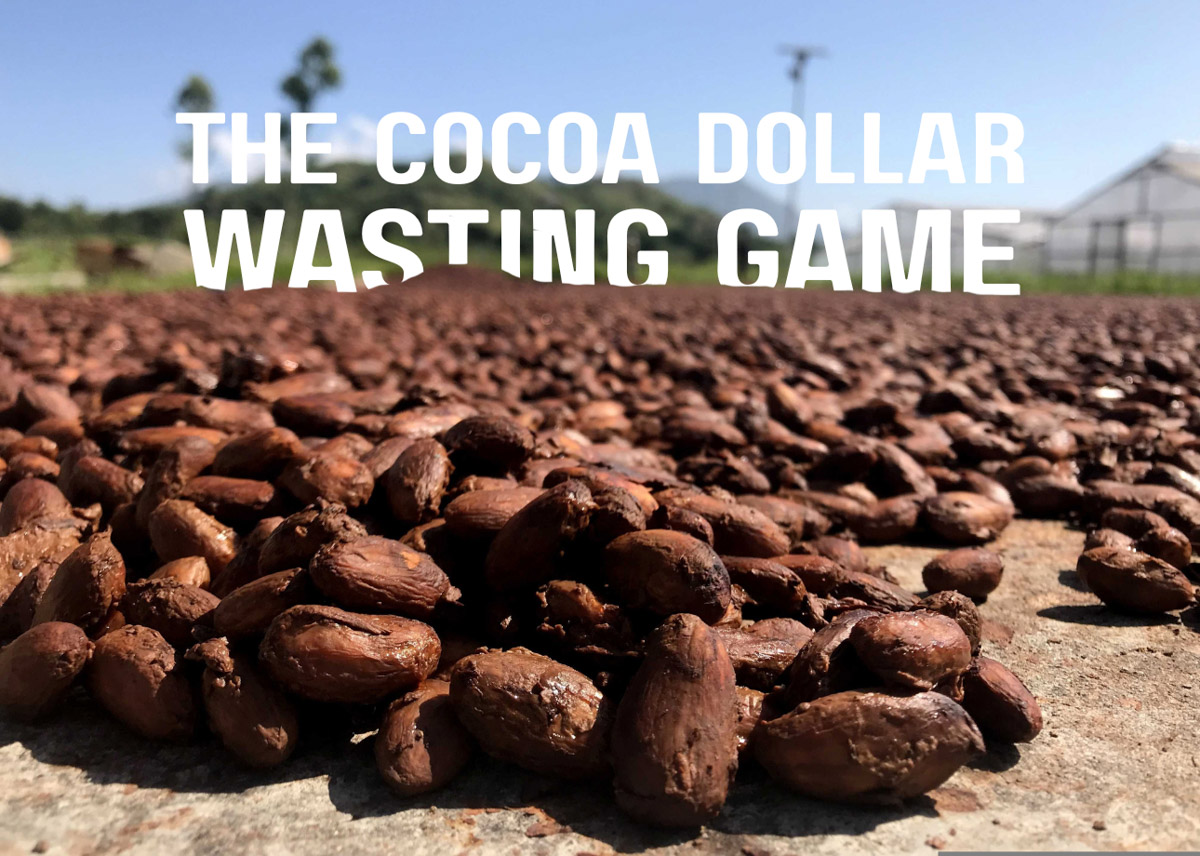
Cocoa is Ghana’s third-highest source of foreign income, after gold and crude oil. It brings in between US$2 billion and US$3 billion a year, enough, one would expect, to pay cocoa farmers a reasonable price for their toil and care. Yet, despite healthy revenues after expenses and sizeable international loans, farmers have gone unpaid for extended periods, with some reportedly receiving no payment for crops since November last year, according to Reuters. More recently, cocoa buyers, those who purchase cocoa from farmers on behalf of COCOBOD, warned that because the agency has not paid them for past deliveries, they may be unable to buy cocoa from farmers during the coming harvest season, according to IntelliNews.
“These smiling farmers are propaganda”
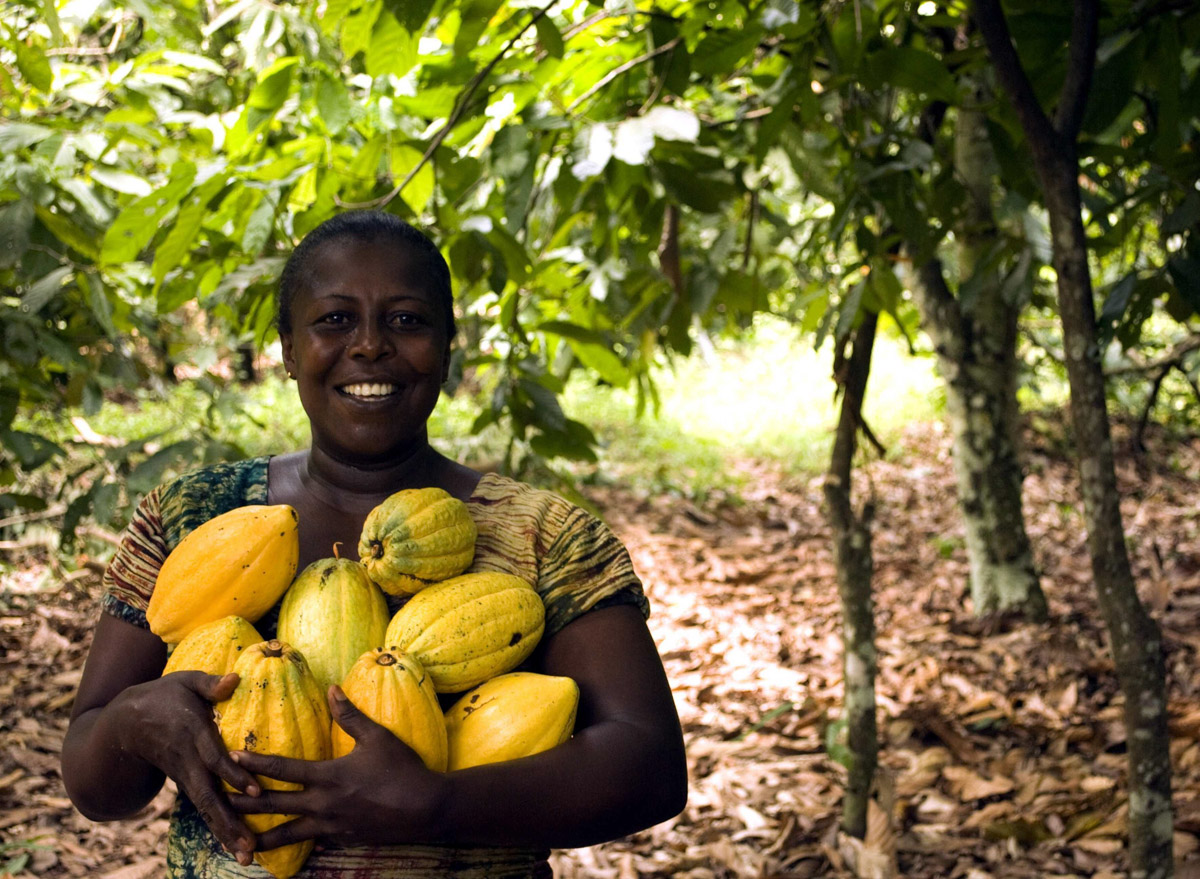
Many Fair Trade and other cocoa certification labels sell chocolate to Western consumers at prices above the average. Posters commonly found in Western supermarkets feature smiling African farmers and promise that the higher price will translate into greater rewards for individual producers. But an investigation conducted 13 years ago in four African countries, including Ghana, found that cocoa farmers working with Fair Trade were often unaware that they were supposed to receive the advertised premium, and that the benefits generally amounted to little. At one cooperative in Ghana, the investigation found that Fair Trade membership fees actually exceeded the promised benefit.
“The system for the farmer remains the same anyway,” says Emmanuel Dogbevi. “All buyers (including Fair Trade and certification companies) buy from farmers and sell to COCOBOD. The profit goes to COCOBOD.” Dogbevi recalls an example of a “smiling farmer” featured on such a poster in another sector, involving “fair pineapples”, who was traced by a Dutch investigative journalist and found never to have benefited from the scheme at all. “Even the name mentioned on the poster was wrong. These smiling farmers are propaganda.”
Then what could concerned Western consumers do differently? “Demand that Fair Trade and all chocolate companies do the right thing. They can also put pressure on agencies like COCOBOD.”
Cocoa farmer, sourced via Pixabay
The COCOBOD agency is also tasked with assisting farmers with agrochemicals, equipment, training and other services, but has often been found wanting in these areas too. Over the years, farmers have protested against unsuitable equipment, hazardous spraying and a general lack of consultation.
Growing debt
To cover gaps in its expenditure and operations, COCOBOD has continued borrowing internationally, mostly imprudently, Dogbevi recounts in the GBN story. “Between 2018 and 2021 alone, the debt grew five times in size.” It is therefore not surprising, he says, that — as he found in the leaked documents investigated as part of the ICIJ project — China’s ICBC bank placed COCOBOD on a red lenders’ watchlist. “But they only joined others who have similar concerns. From my interactions with people in organisations like the IMF and World Bank, they feel the same. During the negotiations for the IMF’s last programme for Ghana, the agency cited COCOBOD’s financial health as an indication of Ghana’s unhealthy economic situation.”
“The lenders are complicit”
Then surely they are right to have these concerns? At a recent “African family values” conference in Ghana, reported on for ZAM by Dogbevi, politicians angrily condemned “Western conditions” attached to grants and funding, claiming that these conditions undermine their “sovereignty” over the country’s natural wealth. But as long as a state agency runs its affairs in this way, might such conditional approaches be reasonable? “Ah, but these lenders are complicit,” Dogbevi says. “They know what is going on. But they hardly raise what they know in public, and they remain on board. Why? Because they benefit from the status quo. If you look at the lending rates at which they provide this money, you realise it’s soft power. They have a share of the economy of the country.”
Colonial model
He adds that genuine sovereignty in Africa, backed by strong, functioning institutions, would not serve Western interests. “The West would probably collapse. If you look at the recent UN decision to redraw the map of the world, resizing Africa, you see that Africa is the largest continent. And it has a lot of wealth. So these global players will continue to play along with the system as is.”
He explains that agencies such as COCOBOD, “that deal with resources and their exports, have been a function of colonialism. Colonialists built these structures so that they could take these resources out of the country. After independence, government after government have continued the model. It became a way of financial empowerment (for a few). You make a lot of money to run the system, to run the political parties and so on. State entities like COCOBOD have a lot of money, so whoever becomes the CEO of COCOBOD is a function of whichever political party is in office. It’s a form of favouritism. When a new government comes into office, they think: well, person X has been useful to our political party in winning the elections; let’s appoint him. Most appointments in Ghana, and I’d say probably most countries in Africa, are rewards. They are not appointing competent people.”
As an example, he says, “The immediate past CEO of COCOBOD was a politician. The one before him was a surgeon. The new one was a TV talk show host for many years. He has a doctorate in business administration, but his experience is mostly in hosting talk shows.”
“The West succeeds thanks to African corruption”
Should the West, and others who want to exploit African natural resources, actually be thankful for nepotism, patronage systems, corruption and mismanagement? “Yes. This is why they succeed. Because most African politicians are in politics to enrich themselves. Which they can do because there is no accountability.” Is accountability a precondition for real sovereignty? “Absolutely. And not necessarily external accountability, but internal accountability. If you look at countries like Ghana, only a few civil society institutions hold government to account. The majority of the people struggle for survival. It’s exhausting. People get tired and overwhelmed. There is a corruption scandal every day. Meanwhile, they are struggling with everyday costs of living. A lot of people cannot afford to rent rooms; they are being forced out of the city. And the corruption continues to bite you personally every day too. If you buy land and you are not careful, you go there one day, and somebody is building on it because it was resold.”
Not enough traction
Is this a challenge for everybody who has a bit of breathing space: to apply pressure for change? “It’s going to take a lot of effort. As I said, there are a few organisations in civil society, but not enough. Stories like this one, which expose the financial mechanisms at play in the system, still don’t get enough traction. Investigative journalism does not pay. You only get a little grant if you are lucky.”
“The government gets money for media, but they won’t fund investigations”
“Ironically, the government receives money for media development, but they won’t spend that money on investigative reporting because it would be like empowering us to hold them accountable, and they don’t want that.”
A new government that came to power last year has expressed concerns about COCOBOD. It has ordered a forensic audit, passed a new law (see box) and severely criticised the previous management. Is that not an indication that these new leaders may at least be moving towards real change? Smiling: “That’s very characteristic of new governments. The former government did the same: they severely criticised their predecessors on assuming office, initiated investigations and, in a few cases, threw one or two people in jail. Then, before long, it was business as usual.”
And even though Ghana’s cocoa income is experiencing a significant boost, mainly because of higher world market cocoa prices and a more favourable exchange rate, Dogbevi’s expectations for accountability on COCOBOD issues remain low. “For now, everybody is cheering because they promised higher prices to farmers again. But they also say they are going to raise the money for that, 1.4 billion cedis, which is close to US$120 million, domestically, because they cannot borrow internationally anymore. As if that’s already a done deal: ‘Just raise it domestically.’ But what happens when they fail to raise that money?”
So far, COCOBOD has not responded to repeated requests for information and comment from GBN and Dogbevi.
Continuing stranglehold
A new cocoa law, promising better minimum pricing, improved governance and even a pension scheme — alongside plans to manufacture more cocoa products instead of exporting only raw cocoa — is purported to make life easier for cocoa farmers in Ghana. But Emmanuel Dogbevi has doubts.“If you read it more carefully, it becomes more of a stranglehold on farmers. For example, you still cannot sell to whoever you want; you can only sell to COCOBOD. You cannot diversify away from cocoa, even if you believe mangoes may be more profitable. You also cannot process cocoa into, for example, cocoa butter or cocoa paste on your farm. You might go to jail if you did that. The only option remains to sell to COCOBOD.”
Emmanuel K. Dogbevi is the managing editor of Ghana Business News.
Call to Action
ZAM works towards a new equal relationship between Africa and Europe. Contribute to our mission by donating.
In December 2025, ArtReview’s Power 100 for 2025 named Ghanaian artist Ibrahim Mahama, celebrated for his textile installations and community-focused art, as the list’s most influential figure...
Ghanaian fishermen who migrated to Europe because of overfishing along Ghana’s coastline have found themselves exploited in the European fishing industry. The companies that depend on their labou...
Rural families in northeastern Ghana and parts of the Sahel have been losing vital farm donkeys—essential for ploughing and transporting crops—to a syndicate that kills the animals for their sk...
How dedicated officials help the public from within corrupted systems In many countries in Africa, public services are inadequate or dysfunctional. Yet some public servants manage to prov...
Ghanaian journalist Enimil Ashon had it on good authority, he wrote in the Daily Graphic on 25 November 2022, that the President of his country had thought that a new candidate applying to head the...