
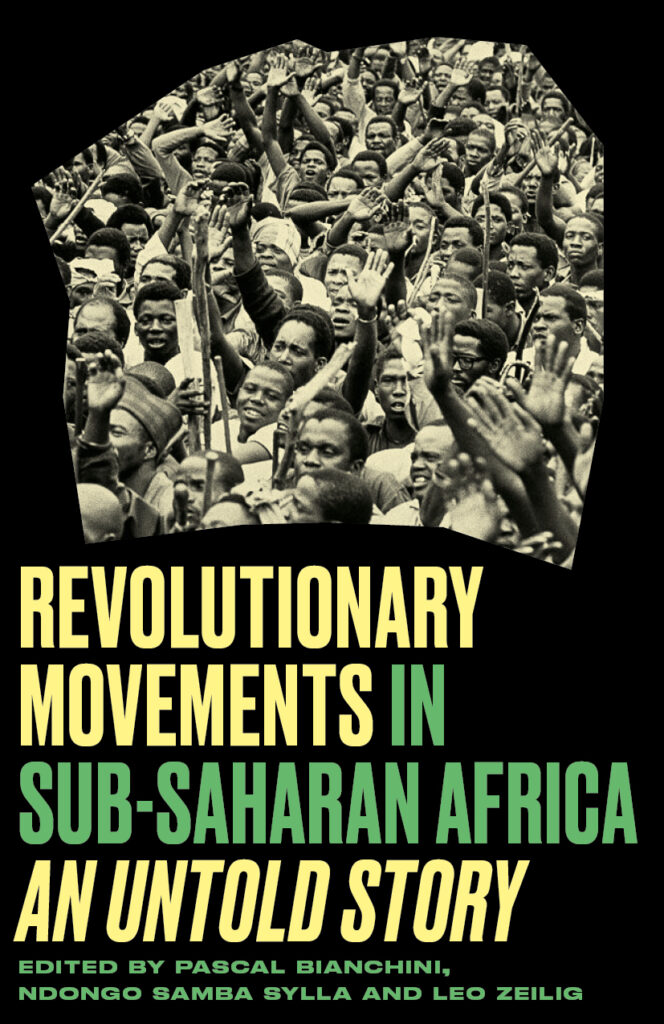
David Sogge recently read a book about a subject close to his heart: the revolutionary movements and thinkers of Africa in the recent past. He comes across them quite a bit in fiction writing, but less so in scholarly work. So he set himself to read about this 'Untold Story'.
Revolutionary Movements in Africa. An Untold Story, edited by Pascal Bianchini, Ndongo Samba Sylla, Leo Zeilig, Pluto Press London 2024.
In African historical fiction, leftist revolutionaries -- activists, guerrillas and militant intellectuals – are abundant. They range from railway workers of Ousmane Sembène to anti-colonial insurgents of Pepetela to radicalised teachers of Ngũgĩ wa Thiong’o. Yet non-fictional accounts of social movements of leftist persuasions (as opposed to writings about leaders such as Sankara and Cabral, or about ruling regimes claiming to be leftist) are, according to the editors of this book, far from abundant. Indeed regarding factual accounts of the leftist movements, the editors use terms like ‘inconspicuous’ and ‘invisibility’.
As suggested in its subtitle, ‘An Untold Story’, Revolutionary Movements in Africa draws together diverse histories to help close that gap in historical knowledge. It is the fruit of a conference held in Dakar in 2019, under auspices of CODESRIA (The Council for the Development of Social Science Research in Africa) and funded by the Rosa Luxemburg Foundation.
In a useful introductory overview, the editors note that the concept of a ‘revolutionary Left’ does not fit easily with most sub-Saharan contexts. They apply the term 'revolutionary' to a broad array of movements. They sketch their historical advances and retreats in three waves. An initial wave took place in the first half of the 20th century when debates and recruitment turned on the question ‘Pan-Africanism or Communism?’. The editors find a second, shorter wave in movements popping up in the final decade of colonial rule. Finally, a rise and decline of activism after 1960 forms a third wave. Most chapters in the book draw on experiences of this third period.
Sensibly, the editors have not limited their chosen cases only to those where Marxism set the tone and the talk. Indeed they write: 'The idea that activists and revolutionaries simply imported ready-made doctrines from a Marxist-Leninist blueprint is at best a narrow point of view, at worst a deeply patronising and colonial idea.' In adopting that stance, they opened the book to a much wider assortment of cases.
Wide diversity
Chapters show wide diversity of political activism. Some of these, such as on Niger, Madagascar, and Upper Volta, cover events and groups broadly in political, civil and military life, often over decades. Others focus tightly on specific times and places, such as the chapter on cultural channels of dissent in Senegal in the 1960s and 1970s, or the chapter on an ‘anti-systemic’ armed movement up to 1979, The National Liberation Front of Chad, seeking a Valhalla in regional autonomy. In that vast Saharan terrain, Marxism is nowhere to be seen. By contrast, battles of ideas among Marxists and their competitors promoting Ujamaa or other development paradigms for Tanzania in the 1960s and 1970s, are the subject of no less than two chapters confined to debates among academics on ‘the Hill’, that is, the University of Dar es Salaam.
At least one chapter, on conflict-ridden South Sudan 1963-1983, does not dodge the question of classical Western Leftism’s relevance. The author states: “However, any radical political education or radical intellectual work in the southern war ran up against a series of problems: local smallholders and communities who did not necessarily frame their political theory in terms of class and imperialism, but in the discourse of racial repression and slavery, the immediate necessities of organising practical unity, funding and fighting, and the search for international recognition and support.'
Two chapters stand out for their quality of historical insight and their alignment with the book’s main theme.
In the 1960s, Congo-Brazzaville became the epicentre of Africa’s leftists and their allies abroad. This was largely thanks to a Congolese youth movement. The authors describe how that movement emerged, built its organisation on the ground, showed concrete solidarity with movements in nearby D.R. Congo and Angola and also drew support from French activists – all with due attention to the Cold War enemies of such movements. That chapter’s scholarship is convincing. It is also relevant today, fifty years later, as youth activism in Africa undergoes a revival.
'The Left is now barely audible'
The chapter on Mali, drawing on the author’s decades of experience in public life and of those persons and organisations in the thick of efforts to shift politics and policy to the Left, is rich in its details and sober in its analyses. Making observations recognisable in other African contexts, he looks back at Mali’s post-independence experience of progressive movements and laments: 'Nowadays, the Left and its discourse have become barely audible. It is sometimes at union level that we still discover some survivals, notably among some teachers’ or students’ unions. And even there, the theoretical level of the discourse of the moment is largely, qualitatively speaking, behind those of yesteryear.'
Five years in gestation, this book’s production left the editors ‘exhausted’ Yet they hint at plans for a second volume, chiefly to make good what in the first volume is missing: Sudan, Ethiopia and much of southern Africa. Yet beyond criteria of states/nations, I wonder if they might take cues from one of this book’s contributors, Issa N’Diaye, author of the chapter on Mali, about which he states: 'It is in the urban peripheries and in the mining areas that social movements are the most significant.' A valid suggestion, one to be supplemented perhaps by other fields transcending national political spaces. Think of movements of shack-dwellers, women’s rights, tax justice and debt campaigners, agrarian workers, and peace-seekers.
This will require creativity according to N’Diaye, who concludes his text with a Malian metaphor: 'Thinking is what turns millet into beer'.