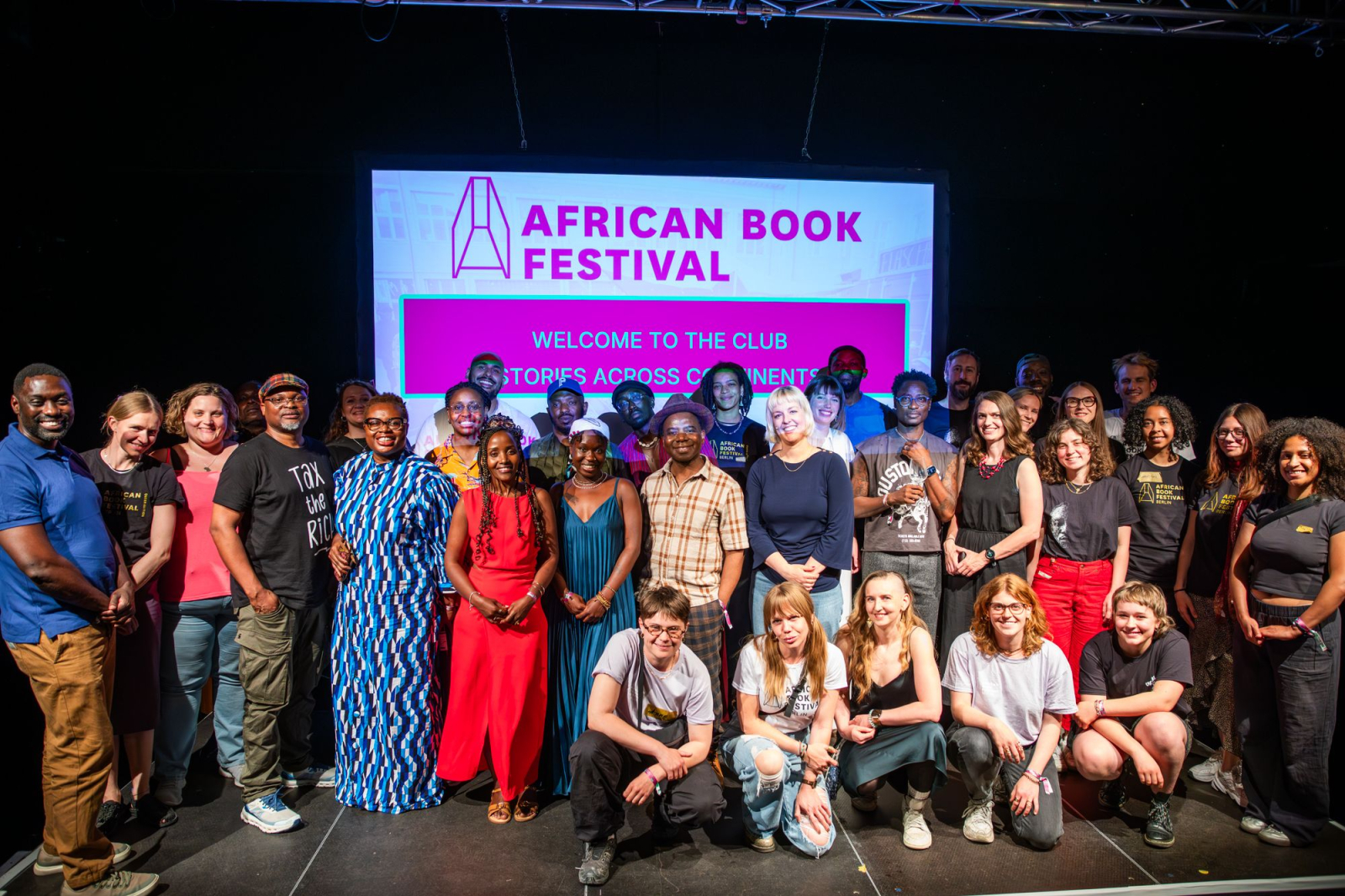
Vamba Sherif is een veelgevraagd schrijver voor literaire festivals over de gehele wereld. Zo belandde hij ook op het African Book Festival in Berlijn afgelopen mei. Read his report in English: great encounters, but those traveling blues...
The German railway is unreliable, I had been told long before boarding the train from Amsterdam to Berlin on a Spring day in May 2026. I will only come to know the true meaning of this warning during my return journey. The first leg of the journey was uneventful but for a half an hour delay, and the train was comfortable, the seats soft, with a table that allowed me to work on my novel, eager to meet the deadline I had set for myself. I was traveling to Berlin to attend the African Book Festival organized by the publisher of Interkontinental Stefanie Hirsbruner, the partner of my brother the novelist Niq Mhlongo, and her team of dedicated people and lovers of African literature.
It was my first time visiting Berlin. Years before, I had made a tour of Germany after the publication of a novel that cost me the least effort to write, Bound to Secrecy, written in one year and published in, among other countries, Germany as Geheimauftrag in Wologizi. The tour was made possible by publisher Peter Hammer Verlag and my friend the great German Bulgarian writer Ilja Trojanow. It began in the Black Forest, in Hausach, a beautiful place where I met one of the most interesting persons in the German literary scene, the poet and publisher of Hanser Verlag Michael Kruger. From what he told me and what I heard about him, his dedication to literature, his work ethics, were perhaps rivaled only by the likes of Thomas Mann. From Hausach, where I spent nearly a week, I travelled to other German cities like Frankfurt, Koln and Stuttgart. I was amazed at the level of enthusiasm and commitment of the German public to literature. While on tour, I discovered the popular German drink Apfelschorle, which became my favorite.
The country’s literature was not strange to me. I had been introduced to it through the work of Thomas Mann whose novel Death in Venice captures, I believe, the essence of the artist like few other works. Goethe’s Faust, which I read in English, was so good that I wondered how the original must have read. I had followed some of the country’s writers like Patrick Suskind, Gunter Grass and many others. I knew the country through its literature pretty well. But its capital, Berlin, had, however, eluded me. In the beginning of my writing career, I won an award given by a group of Africans living in Berlin, but schedules did not permit me to travel to receive it. And last year, I was invited to the African Book Festival, my first invitation, but the festival found me in Tanzania, unable to attend.
I was in my element
Now, I was on the train heading to the city. I arrived at the end of the day, and I checked into a hotel that was more like a hostel, crowded with young people. Downstairs, I met a fellow writer, the Cameroonian based in the UK, JJ Bola, whose book, Mask Off: Masculinity Redefined (2019), attracted lots of attention. He had been to the festival many times, he knew how to find his way in the city. One of the volunteers who had picked me up from the train station led me to where all the writers were meeting, at the bookstore of the publishing house. The Spring sun was bright, and it was beautiful day, and I was in my element, surrounded by people with whom I share the fortune of being chroniclers of the human condition, albeit from an African, European and migrant perspectives. This was what I loved about festivals, the openness, the camaraderie, the joy of meetings.
Next to the bookstore was a restaurant run by a South African with a talent for creating simple but delicious dishes. Behind the bar, serving drinks, was my brother Niq Mhlongo. We had met years ago at Times of the Writer Festival in Durban, the first time I was visiting South Africa. During my stay, while I was walking along the waterfront of that subtropical city, I was suddenly overwhelmed by a feeling I’ve never had anywhere before, the welcoming feeling of being home. No place had ever given me such beautiful almost surreal feeling, the sense that I belonged. South Africa gave me that feeling, which is why it pains me beyond words to see how some South Africans are reacting to their African brothers and sisters, a heartbreaking development and a tragic one for the entire continent.
In tears
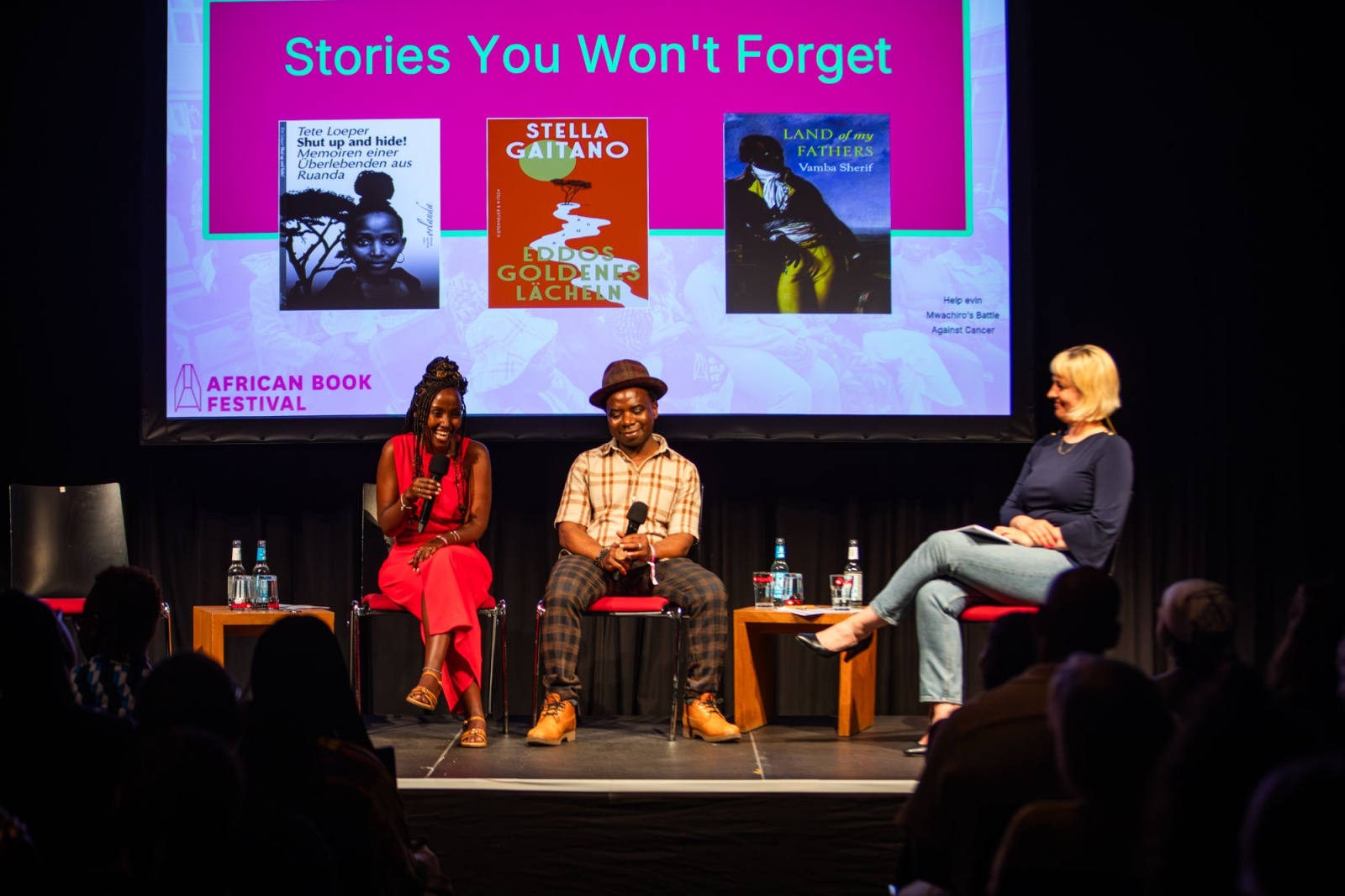
One of the highlights of the festival was during the opening evening, when all the writers were asked to introduce themselves and to response to themes of the festival. I found myself sharing the stage with a writer I had never encountered before, the Rwandan Tete Loeper who had written a memoir, Shut Up And Hide (2025), about the genocide in Rwanda. We had perhaps been chosen to appear alongside each other because our countries have suffered wars, Rwanda a genocide, and Liberia a war that had captured the attention of the world media for years. The next day I burst into tears, together with the whole room, while listening to Tete recount the story of the disintegration of her country and the death of members of her family, including her father. It was so heart-wrenching that I found myself intervening at one point to stop her reading. She herself was in tears. The traumas of war live in some of us migrants, dictating our every action. Some of us are not as fortunate as Tete has been, as I have been, to process these traumas through writing or through another art form. But I often wonder whether processing them alone, in whatever form, is enough, for echoes of such traumas keep resurfacing in our dreams, sometimes during clear light of day, haunting us. They are never truly gone.
The distance between the hostel and the festival venue was covered by foot, and it was always great to find myself walking with a group of writers, engaging in conversation, and discovering personal stories that one cannot get to read about anywhere. I was glad to reunite with my brother Igoni Barett who was with his mother, who I learned had been a teacher all her life, a lady who exuded strength and discipline. Igoni had written a biting satire, Black Ass (2015), a Kafkaesque story about a black man who wakes up to discover that he’s turned into a white man, and after ten years he’s a written a follow-up, Whyteface (2026). I met a Haitian writer, Edna Bonhomme, with whom I was unable to converse at length, but whose work I admired so much, a beautiful memoir, Tending to Our Wounds (2026).
Hilarious
The most hilarious episode of the festival involved the panel, The Literary Quartet, during which writers pitched the books they’ve read and enjoyed and then criticized the ones their fellow panelists had read and loved. The exchange, the banter, the book pitch drew lots of laughter and jeers from the audience. Because we’ve both written historical novels, the South African Karen Jennings and I shared a stage on the last day of the festival, each one of us discussing our respective work, she her novels Crooked Seeds (2024) and An Island (2020), and I my novels Land of My Fathers (2016)and (2024). I liked Karen’s dry humor, perhaps inherited from her Dutch and English past, a surprising and sometimes shocking humor.
The food was the highlight of the festival, and after every session we would stand in a long queue outside in the bright sun in order to relish the various dishes, the most surprising and most appetizing of all to me was the steamed bread, Dombolo, which was served with vegetarian burger and salad. It was so delicious that I kept ordering it every day during my stay. It was around the food that we got to explore aspects other than the themes of the festival. It was here that we got to know each other better, where we took pictures in between the panel discussions, where we converged and separated to form new groups. It was here that I got to talk to other writers like the Sudanese Stella Gaitano, whose great novel Edo’s Souls (2018) I had read and loved so much, and another Sudanese writer Fatin Abbas whose debut novel Ghost Season( 2023) she had discussed when interviewing Stella Gaitano. Fatin told me that she taught creative writing at MIT in the US. I also met Amat Levin who had written a book, Black History, about Africa, and also the Congolese Nadege Kusanika who had written an autobiographical novel Under the Same Sun. I enjoyed the company of the South African author Dudu Busani Dube who, in her gorgeous African clothes, looked like a figure of royalty, and I was infected by the joy and laughter of the Ivorian playwright Edwige-Renée Dro, in whom I recognized an aspect of myself.
Things began to go wrong
Things had gone well for me so far, I had settled in the routine of commuting from my hotel to the festival venue, but things began to go wrong when I learned on the day of my departure that the train that was to leave for Amsterdam had been canceled. This compelled me to take a longer route, which meant switching to three different trains to reach home. Because the railway was unreliable, I should have known that I was taking a great risk. It went wrong with the first train, which arrived too late for me to catch my connecting train. This series of misconnections culminated in my arriving at Bremen at around midnight with the hope of catching a night bus, the Flixbus, to my city more than two hours away. But the train that brought me to Bremen also arrived too late. I rushed to catch the bus, but when I turned the corner at the bus station I saw it pulling off. I waved in desperation, but the bus drove on. I waited for the last bus, thinking that the ticket that I had bought was valid, but when this bus arrived, around 1:00 am, I was told that the ticket was only valid for the bus that I had missed. This meant that I had to purchase another ticket. I tried doing so on the Flix Bus website, but there was a problem with the website, for it kept denying my purchase. The two drivers tried but failed to secure a new ticket for me. I thought that having tried themselves and failed, they would allow me into the bus, but the two men refused. I offered them 50 euros and then a hundred euros for a ride that did not cost twenty euros, but they refused. I was not about to spend the night outside, I told myself. I decided to step into the bus. During the ensuing altercation, my phone fell in the bus, but I was not aware of this. It was only after the bus had left without me, and I searched my pockets did I realized that I had lost my phone.
I had been underway for more than ten hours, I was exhausted, angry at how I had been treated by those two drivers of the Flixbus company, tired beyond words. What had begun so beautifully, a memorable week with fellow writers, had ended in a nightmare.
I had to get home, I told myself. So I pulled myself together and walked to a nearby hotel which I booked for the night. It was around 3am in the morning. I entered the hotel, too rattled by what had happened to sleep, and I lay down but did not close my eyes. I just wanted to lie down. After an hour and half, I took a long shower, dressed in clean clothes and took the first train out of Bremen. I arrived in my city around 8am, took a taxi home and went to bed. Homecoming had never felt so sweet.