
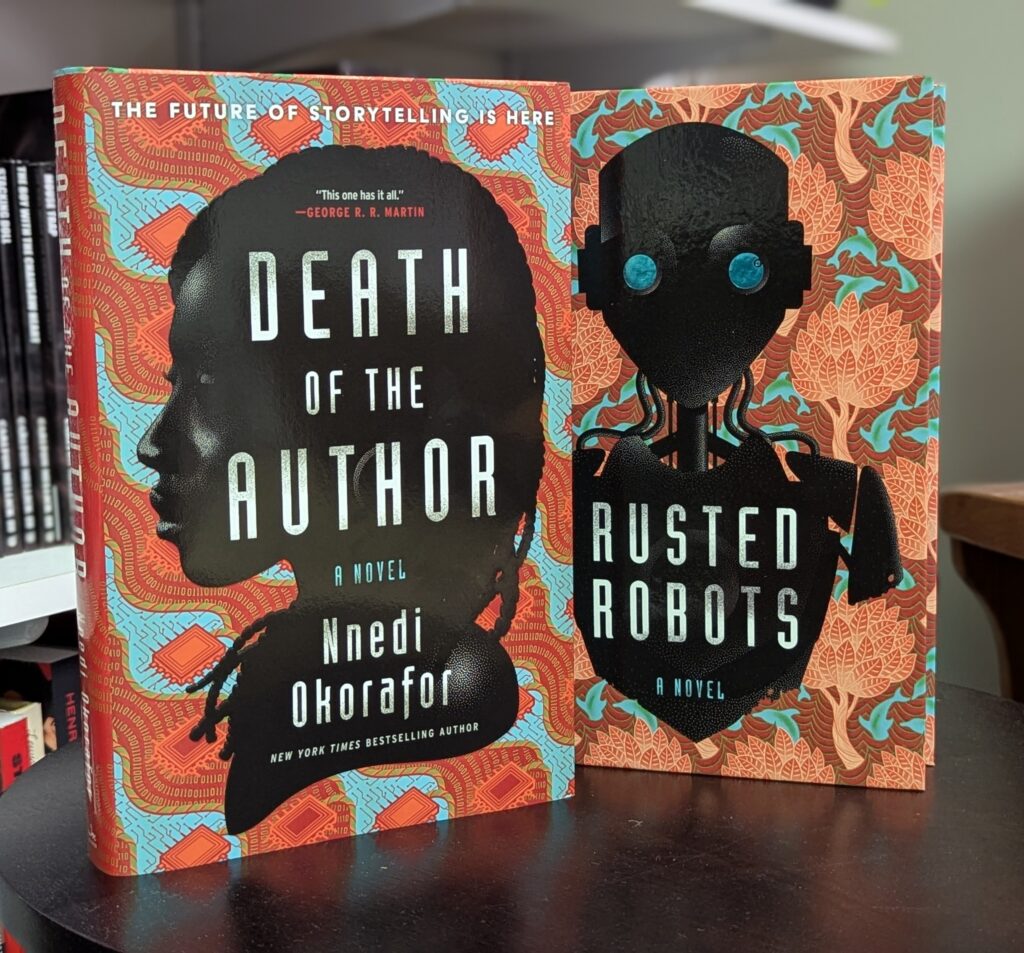
A book within a book, a plot rich with cultural perspectives, an author in the age of social media: the sheer number and variety of themes in Nnedi Okorafors Death of the Author is mind-bogling. But Chinyere Anichukwu felt as an insider to the novel.
Death of the Author is a blend of sci-fi and literary fiction. The main character is Zelu, a paraplegic Nigerian American woman who was an adjunct lecturer and writer and decides to write a story about robots while experiencing loss and hurt. The gripping suspense kept me engaged till the end of the book.
The novel is broken up into three parts: the literary fiction aspect exploring Zelu’s story, the sci-fi narrative of the robots, and the interviews with those close to Zelu, showing how they make sense of her as a person and why she does what she does. Zelu is whom we would term the 'black sheep of the family' in a typical Nigerian home. But you can sympathize with her and eventually understand why she makes the choices she makes.
Over time, we begin to see Zelu’s life and choices blur with the Rusted Robots story. She gets her 'exo's' - artificial, ai-driven, experimental legs - just like robot Ankara in the Rusted Robots-part is given a new leg. Zelu's reality begins to intertwine with that of the robots, as she constantly finds herself yearning to be alienated from the human race.
Book within a book
Nnedi Okorafor's attempt at a book within a book is a strong example of an author using a story to explore broader societal topics. One of these is stories, traditions and heritage, and for me as someone from a background rooted in heritage, it was refreshing to see how this was reflected through both Zelu and Ankara’s character.
Stories encapsulate our human essence, and throughout the book we see the power of stories and who interprets them, and how important it is to preserve them, especially oral traditions. We also see the conflict in Zelu’s identity as an author and as a person whose life is shaped by her identities as a paraplegic and a Nigerian American woman.
There is much context and nuance beneath the layers. The plot is rich with cultural perspectives. I appreciated how Okorafor addressed tribalism, showing its existence between the Ghosts and Humes, an issue that is prevalent in the culture of Nigeria today and one that stood out to me. I would have loved it even more if this theme had been further developed during Zelu’s trip to Nigeria to see her father’s grave.
Ultimately, I viewed this book as the successful author Nnedi Okorafor writing about another successful author, Zelu, while exploring the intricacies of the world of writing, the prejudices involved, social media and fame, forging one’s identity, and standing firm in what you believe in, despite the challenges within the writing world.
Themes and broader societal topics
The book explores how the cancel culture Zelu experienced, is prevalent in media. It shows how quickly one can rise to fame and fall, as well as the toxic relationship between authors and their audiences. It also highlights the pressure of publishing and how burdensome it can be. We see how Zelu’s life intertwines with her work and how her audience perceives her.
While some readers appreciate that a book focused on the absence of a body (Rusted Robots) is written by a paraplegic woman, others criticize Zelu, claiming she took an 'easy' or privileged route by getting artificial legs. Some even call her a robot herself simply because she writes about them.
This ties into how Okorafor addresses representation, especially of people living with disabilities, and how they experience alienation and dismissive attitudes in today’s world. It would be interesting to see how the reception of the book in Nigeria differs from that in the US, particularly with the erasure of Nigerian culture and traditions, and how entertainment industries like Hollywood tend to reshape cultural narratives they are not comfortable with.
Loneliness is explored through Zelu’s story and her disconnection from her family, despite their version of care and love for her. It captures what it feels like to be alienated among family and friends in today’s world. Her immediate and extended family dynamics are central to the story sometimes frustrating to read, but still insightful in understanding how they interpret her choices.
My Expectation
The connection between the sci-fi elements and Zelu’s life became most apparent to me at the point where she gets the exo's legs. However, I did feel a bit lost in the middle of the book because I could not clearly see how the robots connected to Zelu’s story at that stage. I would advise being patient and reading through, because it all comes together beautifully towards the end, where everything begins to align.
I read this from both an insider and outsider perspective—an insider because I am Nigerian and Igbo, and an outsider because this is the first book by Nnedi Okorafor that I have read, and I am not particularly familiar with sci-fi books. Okorafor draws clear parallels between Zelu’s own experiences and her writings about robots. In the end, everything ties together meaningfully.
Overall, I enjoyed this book and felt like an insider through the story’s settings, cities, people, and Igbo traditions, which made me feel deeply connected to the book. I will definitely read it again in the near future, as I am sure I will gain new insights from it.
Chinyere Blessing Anichukwu is a Nigerian Igbo woman, a professional in the heritage and museology sector. She is living in the Netherlands for over five years now and enjoys reading and watching psychological thriller shows. She currently works for Nigerian Youths in the Netherlands (NYN) as the marketing and sponsorship manager.